
Prices and bills
21 November 2026
£100 energy payment covers 11 days of January bills, says think tank
The Resolution Foundation says the £100 Household Energy Payment would cover about 11 days of a typical family's energy bills in January 2027.
4
New permitted development rules for home solar took effect in England on 27 August 2026. Most roof panels still need no planning permission, but listed homes now do.
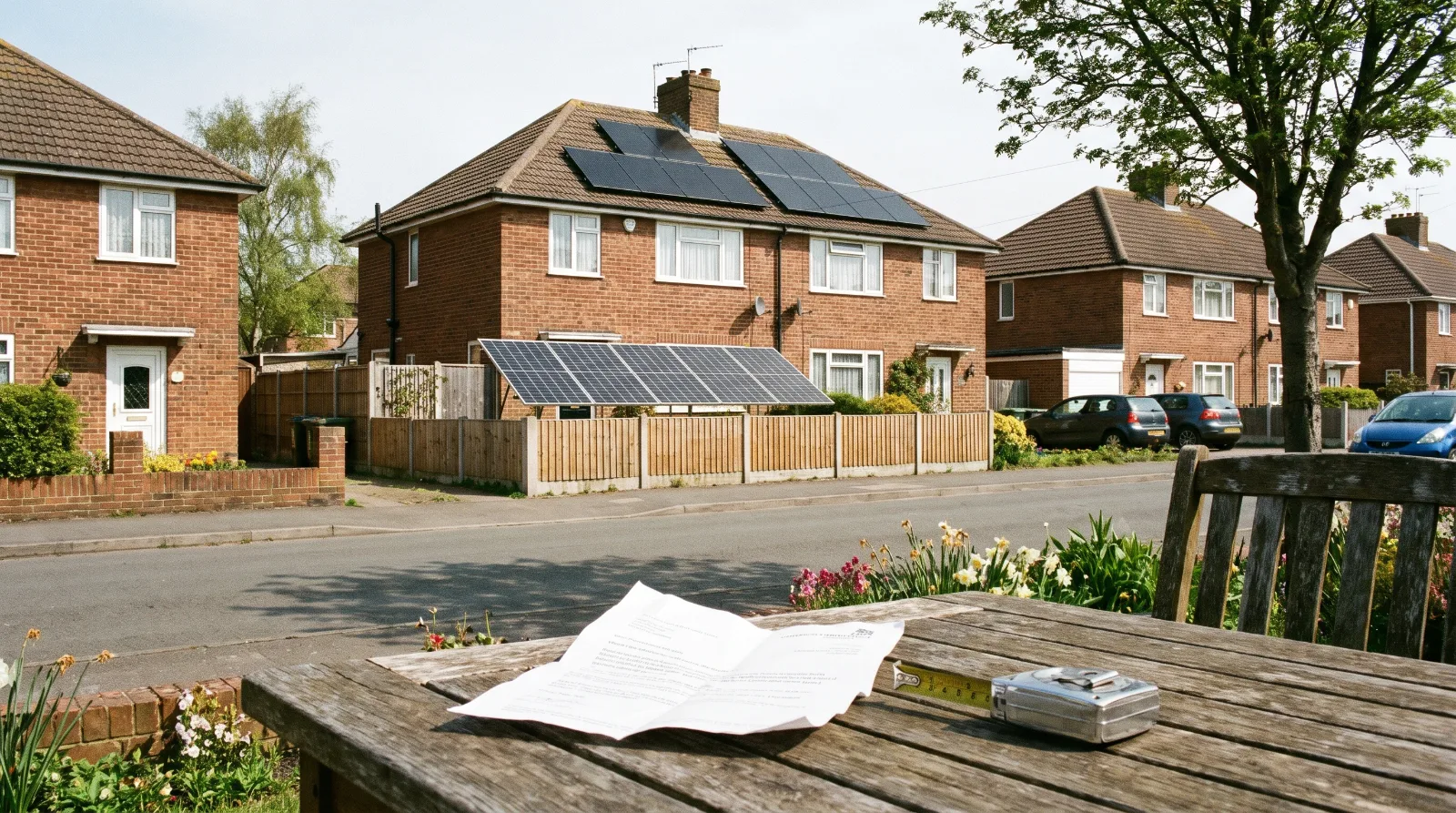
On 27 August 2026, new permitted development rules for home solar came into force in England, through the Town and Country Planning (General Permitted Development) (England) (Amendment) Order 2026. Permitted development means you can do the work without applying for planning permission, as long as you stay within set limits.
For most homeowners the answer to whether you need planning permission for solar panels is still no. But the limits have moved, so here is what changed and what it means for you.
Little has changed. Under the Planning Portal's guidance, panels on a sloping roof are permitted development if they:
The highest part of the equipment must be no more than 600mm above the highest part of the roof. If your home is on designated land, such as a conservation area, national park or World Heritage Site, you must apply to the council for prior approval before fitting panels on a flat roof.
Wall-mounted panels can now project up to 0.4m from a wall, balcony or roof enclosure, up from 0.2m. The 0.2m limit still applies where the wall faces a road. In conservation areas and World Heritage Sites, panels still cannot go on a wall, balcony or roof enclosure that fronts a road.
This is the biggest change. The old rules kept free-standing arrays at least 5 metres from the boundary. They now have height limits instead:
The array must still be no larger than 9 square metres. Some cases in conservation areas and other designated land need prior approval.
If your home is listed, solar panels on it, or on buildings in its grounds, are no longer permitted development. You will need planning permission as well as listed building consent, which was already required for work affecting the building's character.
The rules now cover plug-in solar kits too. They follow the same limits as other panels, and for fire safety they cannot be fixed to wooden walls, balconies, fences or timber cladding. Our post on plug-in solar in Great Britain covers the rest.
Anything that was permitted under the old rules, but is not under the new ones, can still go ahead under the old rules until 26 August 2027.
These rules cover England only. Wales, Scotland and Northern Ireland set their own. Our solar panel buying guide takes you through the rest of the process.


Get a free, no-obligation quote from a vetted installer near you.
Free and no obligation. We only share your details with the installers we match you with.