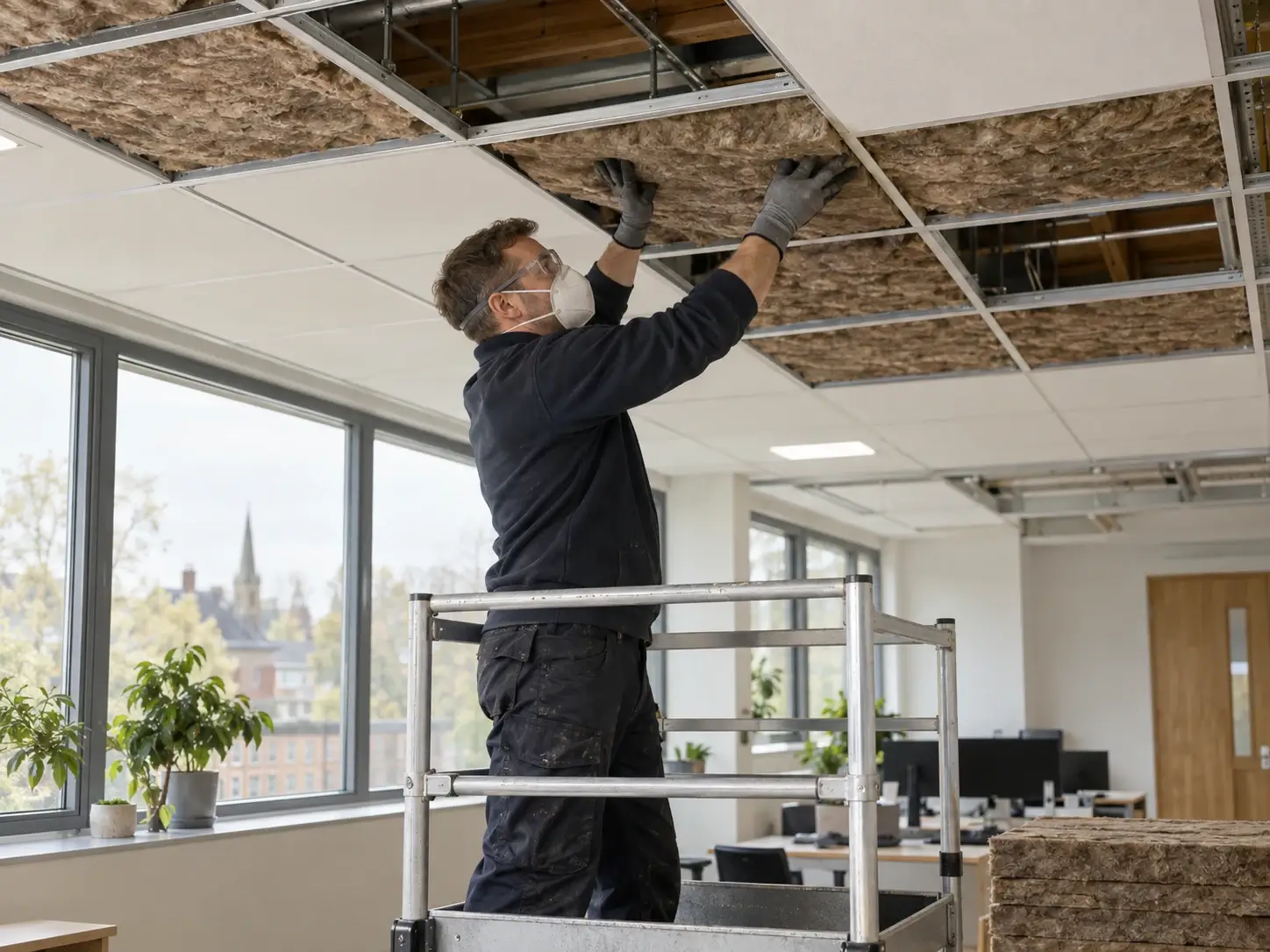
- Poorly insulated buildings can lose up to 58% of their heat through the roof and walls alone.
- Commercial landlords must meet Minimum Energy Efficiency Standards (MEES). Falling short can restrict your ability to let a property at all.
- You can cut the cost of commercial heating and cooling by as much as 40% when you invest in insulation.
Uninsulated or under-insulated commercial buildings can lose 25% of their heat through the roof alone, and another 33% through the walls, according to the Energy Saving Trust. That is 58% of the heating you generate, and are paying for, lost to the wind.
For a business, that is not just a chilly Monday morning. It is real money disappearing through the fabric of your building, every billing cycle, for as long as the problem goes unfixed.
This guide walks through what commercial insulation actually is, why it matters for compliance and cost control, which materials suit which types of business, and what it typically costs. Whether your goal is cutting overheads, hitting a sustainability target, or simply stopping your office floor turning into a sauna every July, this is the practical starting point.
What is commercial insulation?
Commercial insulation is any material installed in a non-residential building, whether an office, warehouse, retail unit, hotel, factory or school, to slow the transfer of heat in or out. It works on the same principle as insulating a house, just scaled up and often built tougher for larger spans, higher ceilings, industrial processes and stricter fire and safety requirements.
It can be installed in and around:
- Roofs and ceilings, often the single biggest source of heat loss in large, single-storey buildings like warehouses
- External and internal walls, whether cavity, solid wall or cladding systems
- Floors and ground slabs, particularly for ground floor spaces
- Pipework, ductwork and hot and cold water systems, to optimise thermal efficiency and prevent freezing
- Partition walls, for thermal and sound separation between units, offices or guest rooms
Put simply: if it is part of the building envelope, or it carries heat somewhere it should not, there is usually a commercial insulation solution for it.
Why commercial insulation matters
This is not just an energy-nerd concern. It is a business one.
Heat loss and wasted spend
Every degree of heated, or cooled, air that escapes through an under-insulated wall or roof has to be replaced at your expense. With heating and cooling accounting for 40 to 60% of a business's energy consumption, that is a lot of money stacked onto your bill unnecessarily.
Insulation contains your energy, and the cost of producing it, inside your building. Which means a highly efficient commercial boiler does not need to work as hard, or for as long, to heat the place.
Minimum energy performance standards
Under the UK's Minimum Energy Efficiency Standards (MEES), most privately rented non-domestic properties need to meet at least an EPC rating of E, with government proposals in recent years to tighten this further.
Fall short, and landlords can in some circumstances be restricted from granting or continuing a lease. Poor insulation is not just an efficiency issue, it can be a genuine commercial risk.
Net zero targets
The UK has a legal commitment to reach net zero emissions by 2050, and non-domestic buildings are a meaningful part of that picture. Insulating now puts your business ahead of tightening building regulations, rather than scrambling to catch up later at potentially higher cost.
Future-proofing against energy prices
Wholesale energy markets have shown repeatedly that they can move sharply and with little warning. Businesses do not get the safety net of the Ofgem price cap, which means commercial gas bills can soar well beyond what you pay at home.
Reducing how much energy your building needs in the first place is one of the most reliable hedges against volatile prices a business can make.
Comfort, productivity and reputation
Poorly insulated buildings run cold in winter and hot in summer, which is not ideal for staff, customers or stock. Increasingly it also matters to tenants, investors and customers who factor Environmental, Social and Governance credentials into who they work with. Even a single insulation investment can do a lot for your reputation and for day-to-day comfort.
What insulation types are suitable for businesses?
There is no single best commercial insulation material. The right choice depends on the building, the application and the budget. Here is how the main options stack up.
Quick glossary: what is a U-value?
A U-value measures how much heat passes through a material or building element. The lower the number, the better the insulation.
UK building regulations set minimum U-value targets for different parts of a commercial building under Approved Document L, so it is worth asking any installer to confirm the U-value their proposed system will actually achieve, not just the material they are quoting.
Types of commercial business and their insulation needs
Insulation needs are not one size fits all. They shift depending on how a building is used.
Warehouses and industrial units. Large roof areas and high ceilings mean the roof is almost always priority one, typically addressed with rigid foam board or built-up mineral wool systems. Loading bay doors and thin-cladding walls are common weak points too.
Offices. Usually a mix of cavity wall, roof and sometimes suspended-ceiling insulation, paired with decent commercial glazing. Consistent temperature matters more than people realise: hot and cold spots in an open-plan office are a fast route to a stream of complaints, and turnover.
Retail units. Constant door traffic makes floor, wall and shopfront insulation especially valuable, often alongside thermally efficient doors so heat is not escaping every time a customer walks in.
Hotels and hospitality. Guest comfort is the product, so insulation between rooms, floors and external walls does double duty: thermal performance to keep rooms cosy, and sound insulation to block slamming doors, clattering luggage and 3am karaoke.
Restaurants and food service. Kitchens generate serious heat of their own, so insulation has to work alongside that. Cold storage and refrigeration areas need their own dedicated, higher-spec insulation.
Healthcare and education. Consistent, well-regulated temperatures matter for patient and pupil wellbeing. These are often large, older estates with genuine retrofit potential and long-term savings on the table.
Signs your building needs better insulation
Not sure whether this even applies to you? A few common red flags:
- Noticeable hot or cold spots in different parts of the building
- Energy bills creeping up even though usage has not changed
- Condensation or damp patches on walls or ceilings
- Staff or customers regularly, and negatively, commenting on the temperature
- Heating or cooling systems that seem to run almost constantly
- An EPC rating of D or below
If two or more of these describe your situation, it is worth getting an insulation installer in for a proper assessment.
How much does commercial insulation cost?
Commercial insulation costs are tricky to pin down as a headline figure, because they vary with the size of your business, the material you use and the area you are insulating. Installer quotes can also vary significantly for the same job.
Costs are shaped by:
- Material choice. Natural fibres tend to be more expensive than mineral wool and fibreglass
- Building condition. Older or irregular structures can mean more preparation work
- Access. Height, roof pitch and site constraints all affect labour time, which adds to the cost
- Whether your business stays operational. Shutting down for the work means it gets done faster, and cheaper
- Regional labour rates. Typically higher in London and the South East, lower across the rest of England, Scotland and Wales. In Northern Ireland prices can swing above and below the national average depending on the type of insulation
Commercial insulation ROI and savings
Insulation is one of the rare business upgrades that both saves money and keeps paying dividends for years after the initial spend.
Potential energy savings
The Federation of Small Businesses estimates that a well-insulated building could cut the cost of heating and cooling by as much as 40% for small-to-medium businesses. So if your small business currently spends £2,000 a year on gas, you could potentially bring that down to £1,200.
That is an illustrative figure. The size of the saving depends heavily on how poorly insulated the building is to start with: a building with no insulation at all has far more to gain than one already partly upgraded. The best savings are unlocked when you pair insulation with a condensing commercial boiler.
Potential payback period
The payback period for commercial insulation is roughly the same as for residential: around 3 to 7 years for loft insulation and 5 to 10 years for cavity wall insulation, according to the Energy Saving Trust. Floor and solid wall insulation have considerably longer payback periods, of more than 20 years.
That said, commercial insulation materials typically last between 25 and 40 years with proper installation and maintenance, so the majority of that lifespan is pure savings once payback is reached.
Here is how to work it out for your own building: payback period in years = total insulation cost ÷ annual energy cost savings.
Beyond the energy bill
ROI is not only financial. Better insulation can also mean:
- A stronger EPC rating, supporting future lettings, sales or refinancing
- Reduced compliance risk under MEES
- Better staff comfort and, by extension, productivity
- A stronger sustainability story for customers, investors and tenders that ask about your ESG credentials
Commercial insulation grants
Unlike some well-known domestic schemes, there is not currently a single blanket grant that gives businesses free insulation. But there are still real routes to reduce the cost.
Capital allowances: the Annual Investment Allowance (AIA). Many types of qualifying capital expenditure, including building improvement works, can be deducted from profits before tax, up to an annual limit set by HMRC.
Full expensing. Incorporated businesses may be able to claim enhanced first-year tax relief on qualifying capital investment. Rules and eligibility change, so check current HMRC guidance before assuming eligibility.
Local and regional support. Some local enterprise partnerships and the devolved administrations in Scotland, Wales and Northern Ireland run their own business energy-efficiency grants from time to time. The GOV.UK business finance and support finder is a good place to check what is currently available in your area.
Grant schemes and tax rules change fairly often, so confirm current eligibility directly with HMRC or GOV.UK before budgeting a project around them. It is also worth asking your accountant how any of the above interacts with your specific tax position.
How to identify the best insulation type for your business
Insulation is a big investment. Get it right the first time and you avoid expensive mistakes.
Assess your business needs. Think about how the space is actually used. Do you store temperature-sensitive stock in the loft? Do staff or guests need consistent comfort? Is noise between rooms or units a factor? Are there fire safety requirements specific to your industry? These answers narrow the field fast.
Check suitability for your building. Consider the age and construction type, how much roof void or wall cavity space is actually available, and any exposure to moisture. Assess planning or listed-building constraints that might rule certain materials or external changes out.
Match it to your budget. Weigh upfront cost against long-term savings, because the cheapest material is not always the cheapest option once energy savings are factored in. A phased approach, starting with the area losing the most heat, usually the roof or walls, can make a larger project more manageable. Factor in any grants or tax relief before finalising numbers.
What is the commercial insulation installation process?
Every project looks a little different, but most follow a similar path from first thought to finished job.
Evaluate suitability. Start by understanding where your building currently stands: its EPC rating, existing insulation levels, and the areas most likely to be losing heat.
Finalise your budget. Set a realistic budget that includes a contingency, and factor in any grants, allowances or tax relief you may be eligible for.
Research and compare installers. Look beyond price. Check for relevant certifications and trade body membership, such as TrustMark for quality and the National Insulation Association. Ask about experience with businesses like yours, because a warehouse specialist may not be the right fit for a hotel, and ask for references from similar projects.
Talk to an installer about your goals. Be upfront about what you are trying to achieve, whether that is lower bills, compliance, comfort, sustainability targets or all four. A good installer shapes their recommendation around your actual priorities rather than a standard package.
Get a free survey and quote. Reputable installers give you a ballpark before conducting a site survey and offering a final quote.
Installation. Timelines vary by project size and material, but most commercial installers can plan around your operating hours to minimise disruption. Ask in advance what to expect on site, and make sure you get the relevant certification and compliance documentation once the work is signed off.
The bottom line
Commercial insulation is one of the few upgrades that pays for itself, helps keep you on the right side of energy regulations, and makes your building a genuinely nicer place to work, shop or stay.
Get the material right for your building, get more than one quote, and factor in any available grants or tax relief, and the numbers tend to make the decision for you.
Ready to see what it could mean for your building?
Get matched with a vetted, local commercial insulation installer and receive a free, no-obligation survey and quote.
Free and no obligation. We only share your details with the installers we match you with.
Sources: the Federation of Small Businesses, and the Energy Saving Trust on roof and loft insulation and on cavity wall insulation.
Ready to see what it could mean for your building?
Get matched with a vetted, local commercial insulation installer and receive a free, no-obligation survey and quote.
Free and no obligation. We only share your details with the installers we match you with.
What the accreditations actually mean
Certification is the clearest signal you have that an installer is competent, and that you are protected if something goes wrong. Here is what each one covers.



Keep reading
Underfloor insulation and draught proofing: cheap fixes for a cold house
Insulation checklist: permissions, ventilation and paperwork
Insulation materials suitable for business premises
There is no single best material. The building, the application and the budget decide it.
Indicative commercial insulation costs
Three worked examples, to give a sense of the range before you get quotes.