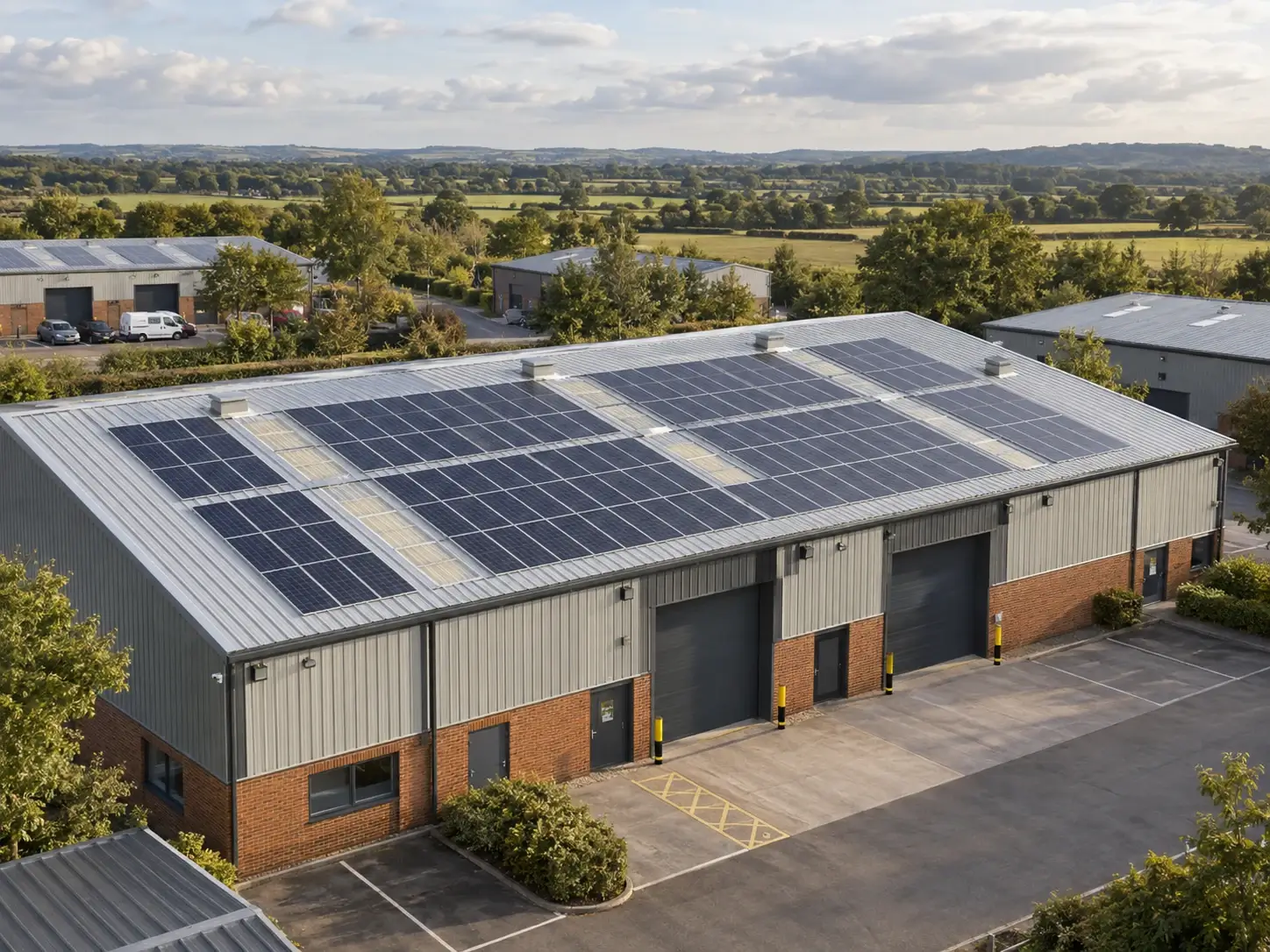
- Commercial solar panels cost an average of £1,317.63 per kW.
- A 100kW system could save around £18,000 a year, paying back in 3 to 5 years for an ROI of up to 45%.
- There is no direct grant for commercial solar, but several tax reliefs and schemes can lower the upfront cost.
Running a business is challenging enough without the threat of rising energy bills looming over your head. Commercial solar panels are your first-line defence against volatile energy price fluctuations, helping you keep your lights on and your doors open.
It is why over 41,000 businesses in the UK have installed solar panels this year alone, according to the latest MCS data. But that still leaves thousands of commercial roofs unaccounted for.
In this guide we give you the facts and figures your stakeholders need to get on board: how much commercial solar panels cost, how much you could save, and why they have become the ultimate future-proofing investment.
What are commercial solar panels?
Commercial solar panels are made up of photovoltaic (PV) cells that absorb sunlight and convert it from direct current (DC) electricity to alternating current (AC). That power is then fed to all of your outlets, powering everything from your lights, computers and machinery to your office kettle.
Any surplus electricity you generate is either stored for later, if you have a solar battery, or sold back to the grid.
Essentially they work the same way as domestic solar panels. The key difference is size. Businesses consume a lot more energy, so they need bigger systems to meet their needs.
Why solar power matters for businesses right now
Solar panels are growing in popularity for very clear reasons: rising energy prices, environmental responsibilities, and a pressing desire for long-term self-sufficiency.
Grid energy is expensive, and it is staying that way
UK businesses were paying an average of 24.14p per kWh in the first quarter of 2026. Small businesses, the ones with the least negotiating power, were paying over 35p per kWh, a new high.
This has a direct impact on business longevity. In a recent British Chamber of Commerce survey, 52% of businesses said utilities costs were forcing them to raise their prices, and 27% said they would struggle to pay their energy bills over the next twelve months.
Solar does not lower your energy bill overnight, but it lets you generate a chunk of your energy yourself at a fraction of the grid rate, around 5 to 9p per kWh according to DESNZ levelised cost of energy figures.
ESG and environmental obligations matter more than ever
Large companies are now legally required to document and disclose their energy use and carbon emissions under Streamlined Energy & Carbon Reporting (SECR) rules.
Solar panels demonstrate clear, measurable evidence of a commitment to green energy, while helping to mitigate a potential 2,700 tonnes of carbon pollution a year.
And it is not only regulators you have to prove yourself to. Customers, clients, investors and tenants care about your environmental impact too. Over half of millennial and Gen Z Britons say they prefer to buy from sustainable and ethical brands, according to Statista.
Solar gives you cost control and long-term savings
Every business that has lived through a volatile energy contract renewal knows the stress of being completely in the dark about next year's electricity costs.
Solar lets you claw control back from the grid by increasing your self-sufficiency. With a solar system installed you can typically reach 30 to 60% self-sufficiency. Add battery storage and that rises to 80 to 90%.
A business generating 95,000 kWh a year from a 100kW system could save roughly £18,000 in the first year alone, using tax reliefs and the Smart Export Guarantee. That is a system paid back in 3 to 5 years, with twenty-odd years of free electricity afterwards.
The best types of commercial solar panels
There are three main types of commercial solar panel available today: monocrystalline, polycrystalline and thin-film. You also have bifacial panels, which are a type of monocrystalline or polycrystalline panel with an energy-efficient twist that delivers real benefits for some commercial properties.
Monocrystalline solar panels
Superior performance, unmatched longevity.
Monocrystalline panels are cut from a single crystal of silicon, which lets them reach efficiency levels of 18 to 24% and perform well on limited roof space.
They cost more than other types, around £400 to £500 per panel depending on the manufacturer. But with a daily output of 4.91 W, over double that of polycrystalline, the higher price is usually justified for businesses generating significant daytime energy. With roof space and structural load being the key pain points for most businesses, monocrystalline is the best solution for higher output per square metre.
Best for: commercial buildings with limited roof space, seeking high energy performance and longevity.
Polycrystalline solar panels
Polycrystalline panels are made from multiple silicon fragments melted together. That make-up makes them cheaper to produce, which is a significant plus on a tighter budget. Compared with monocrystalline they are less efficient at 13 to 16%, have a shorter lifespan of 25 to 30 years, and produce lower average output per panel at 2.22 W a day.
That does not make them a poor fit. Warehouses, factories and agricultural buildings often have expansive, unshaded roofs that can take more panels, so you can install more polycrystalline panels to reach a similar output at a lower upfront cost.
Best for: commercial buildings with large roofs, where lower upfront cost matters more than maximising every square metre.
Thin-film solar panels
Thin-film panels have the lowest efficiency of all, around 7 to 13%, and tend to last only 10 to 20 years. They are generally unsuitable for traditional commercial roofs, but their versatility makes them a good fit for specialised ones.
They are very lightweight, so they can go on roofs where weight capacity is an issue, and they can be placed on vertical walls, curved roofs and low-pitch roofs. If your building is on the unconventional side, thin-film could be worthwhile where maximising efficiency is not the priority.
Best for: commercial roofs that cannot take traditional panels because of bespoke or unconventional designs.
Bifacial solar panels
This is where the game changes for commercial solar. Bifacial panels, typically built using monocrystalline cells, absorb sunlight from both sides of the panel rather than just the front.
Placed on reflective, flat or elevated roofs, or used as a ground-mounted system, they can generate an additional 5 to 45% of electricity per panel, according to Heriot-Watt University research. For large commercial or industrial installations they are the clear winner for maximising yield, though they cost around 10% more than one-sided monofacial panels.
Best for: commercial buildings with flat or elevated roofs, along with ground-mounted or reflective systems.
How much do commercial solar panels cost?
Commercial solar is usually quoted per kW, the system's maximum output under peak conditions. According to the MCS Data Dashboard, the average cost of commercial solar so far this year is £1,317.63 per kW.
So the average cost of commercial solar panels is around £33,000 to £130,000, because most businesses can efficiently use a 100kW system or smaller. Prices vary significantly with the size of system you need, how much energy you consume, where you are, and how complex the installation is.
- Micro to small businesses use around 10,000 to 35,000 kWh a year, according to Business Energy UK, so a 25kW system is usually sufficient.
- The average medium-sized UK business uses 60,000 to 115,000 kWh a year, which typically means a 50 to 100kW system.
- For large businesses, consumption averages around 150,000 kWh a year, requiring a 250kW or larger system.
A business open 24/7 will of course consume far more than one working 9 to 5 and closing at weekends, so you will need to look closely at your own usage to get a real picture of the cost.
Solar panel ROI
If you want significant returns, solar is one of the smartest investments a business can make.
These are not set-in-stone figures, and there is plenty of potential for bigger savings. What you actually save comes down to two factors.
Self-consumption. The more daylight energy you use on site, the faster your payback. Businesses with high, consistent usage, such as 24/7 industrial estates or multi-site operations, may reach 80% self-sufficiency, accelerating ROI because they offset more of their energy costs faster. A 9 to 5 office at 50% self-consumption will sell more back to the grid at a lower rate, slowing ROI down.
System size. Bigger systems generate more energy, and whether it is used or exported that scales savings and ROI. They also benefit from economies of scale, which typically reduces the cost per kW even though the initial outlay is higher.
In a nutshell: commercial solar has an average payback period of 2 to 6 years, ROI runs between 16 and 45% according to the Solar Grid Check, and the higher your self-consumption the bigger your annual savings and the faster your payback.
Are there any commercial solar panel grants?
Short answer: not exactly. Unlike grants for homeowners, there is no direct cash funding for installing solar panels on commercial buildings. What you get instead is tax relief, which often delivers more financial value to a business than a grant would anyway.
- The Annual Investment Allowance lets eligible businesses deduct 100% of qualifying solar spend, up to £1 million a year, from pre-tax profits in the year of purchase.
- Local growth hubs and regional grants are sometimes available, offering funding pots for commercial decarbonisation. They tend to appear and disappear without much notice, so it is worth checking the GOV.UK Business Finance and Support Finder regularly.
- The Smart Export Guarantee pays you for every unit of electricity you do not use. Self-consumption is always more profitable long term, but the SEG can deliver an ongoing revenue stream that helps pay back your investment.
- A Power Purchase Agreement (PPA) is a long-term contract with a renewable energy supplier under which your solar developer covers the upfront cost of installation, maintenance and insurance. The upside is zero upfront cost. The downside is a long tie-in, and you do not own the panels on your roof.
Does my business need solar power?
From small family-run cafes to large manufacturing sites, any industry can install solar panels to reduce energy bills and carbon footprint. The industries that tend to benefit most include:
- Agriculture and farming
- Technology firms and data centres
- Hospitality and tourism
- Manufacturing
- Healthcare
- Retail and commercial enterprise
Choosing the best commercial solar panels
Energy consumption
If your system is too small it will struggle to meet your daily consumption and under-deliver on savings. If it is too big, and you have no battery, you will export the surplus back to the grid at a lower SEG rate, stretching out your payback unnecessarily.
Roof size and suitability
The ideal roof is south-facing, unshaded and at a 30 to 40 degree angle, undamaged and with a long chunk of its lifespan left. You do not have to meet all of those conditions, but orientation, pitch, shading, available space and condition all affect the cost and feasibility of the install.
Planning and regulatory constraints
Most commercial buildings will not need planning permission for roof-mounted solar, as it generally falls under Permitted Development Rights. If your business is in a listed building, conservation area, historic site or World Heritage Site, you may need to apply. The same goes for ground-mounted systems larger than 9m².
Battery storage
A battery can be worthwhile for businesses with high consumption or evening operating hours, letting you store daytime generation and use it on demand. It can increase self-sufficiency and cut bills by a further 20 to 40%, but at around £500 to £600 per kW it is a significant investment that lengthens payback.
Setting a realistic budget
There is no shying away from it: solar is not cheap. Buying outright delivers value fastest, but PPAs, regional grants and the Annual Investment Allowance can all help a business install solar on a realistic budget.
The commercial solar installation process, step by step
- Suitability check and initial quote. Get a quote from a verified installer, who will check your roof's suitability, usually by satellite. This gives you a ballpark figure based on your energy usage, system size and panel type. Getting a quote should always be free, with no commitment.
- Site survey. An installer performs a structural and electrical check, assesses your roof's condition, materials and access, and identifies any work needed before installation can start.
- Design and proposal. You get a complete system design, payback estimate and fixed-price quote. Verify credentials such as MCS and NAPIT here, along with business specialisms, warranties and reviews, before signing anything.
- Grid and permissions. Your installer handles any grid connection applications, such as G99 DNO, needed for the install.
- Installation. From assessment to commissioning, rooftop commercial systems are typically completed within 6 to 16 weeks depending on access, size and complexity. Ground-mounted systems can take several months because of planning and grid requirements.
- Commissioning and MCS certification. Your system undergoes electrical testing, safety inspection and MCS approval. Once it passes you can register for the Smart Export Guarantee.
- Monitoring and maintenance. The best installers monitor your system remotely and carry out annual inspections to keep it performing.
Thinking about buying commercial solar panels?
In the battle against rising energy bills and net-zero targets, the best solution could be right above your head. Commercial solar is a straightforward win with fast, proven payback potential.
Thinking about solar for your business?
Get a free, no-obligation quote from an MCS-certified installer. They can give you a tailored price, walk you through the available funding and tax reliefs, and survey your site to work out the best setup.
Free and no obligation. We only share your details with the installers we match you with.
What the accreditations actually mean
Certification is the clearest signal you have that an installer is competent, and that you are protected if something goes wrong. Here is what each one covers.



Keep reading
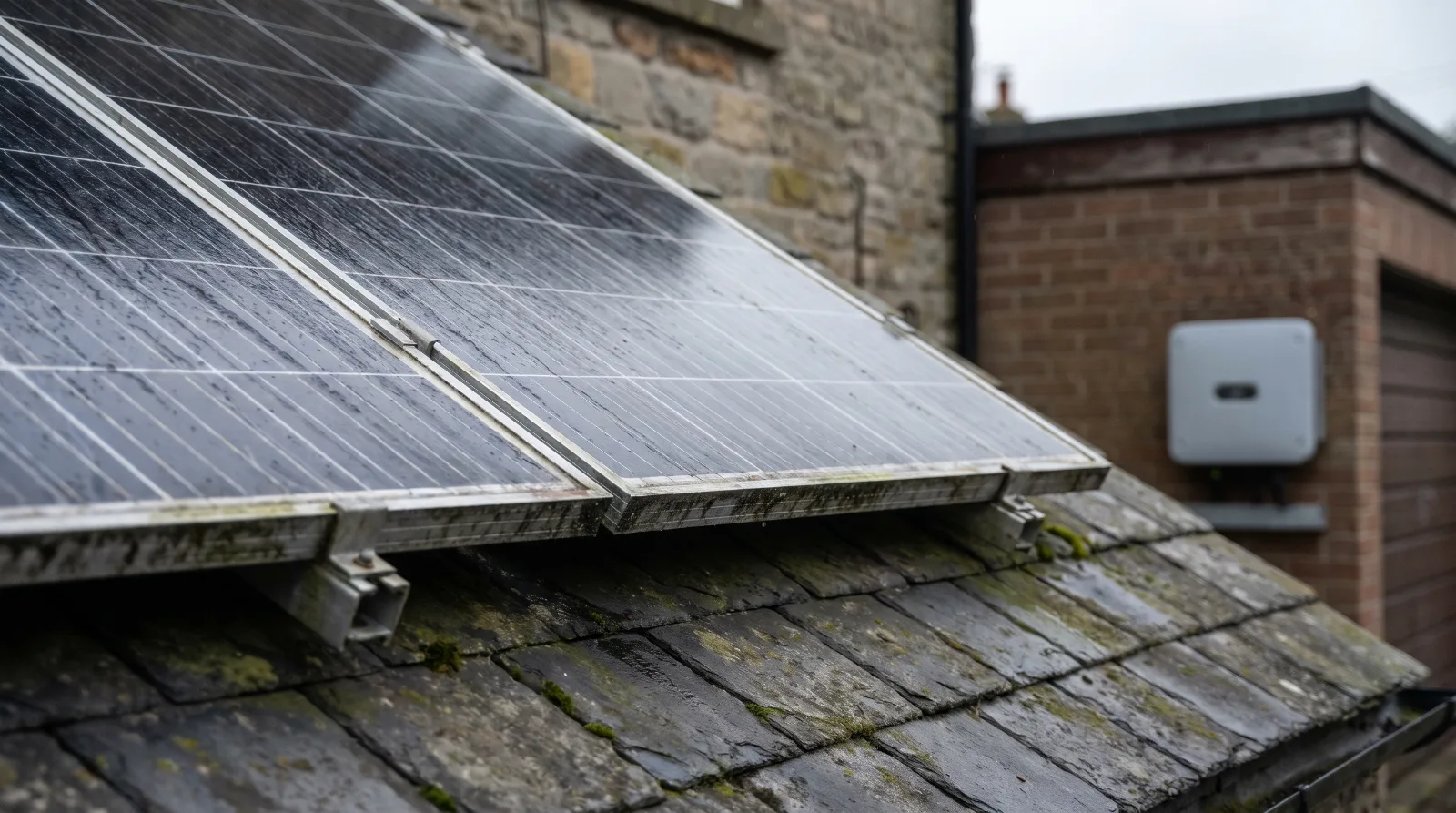
How long do solar panels last? Lifespan, warranties and upkeep
How to choose a solar panel installer: 9 checks before you sign
Commercial solar panel types compared
The three main panel types, plus bifacial, side by side before the detail below.
Commercial solar panel costs by system size
Indicative installed cost, calculated from the MCS average of £1,317.63 per kW.
System size follows energy use, so it is worth knowing roughly where your business sits before you get quotes.
- Micro to small businesses use around 10,000 to 35,000 kWh a year, so a 25kW system is usually sufficient
- Medium-sized businesses average 60,000 to 115,000 kWh a year, which typically means a 50 to 100kW system
- Large businesses average around 150,000 kWh a year, requiring 250kW and above
A business open 24/7 will consume far more than a nine-to-five that closes at weekends, so look at your own consumption rather than the band you appear to fall into.
Commercial solar return on investment
What a system of each size typically saves a year, and how long it takes to pay for itself.