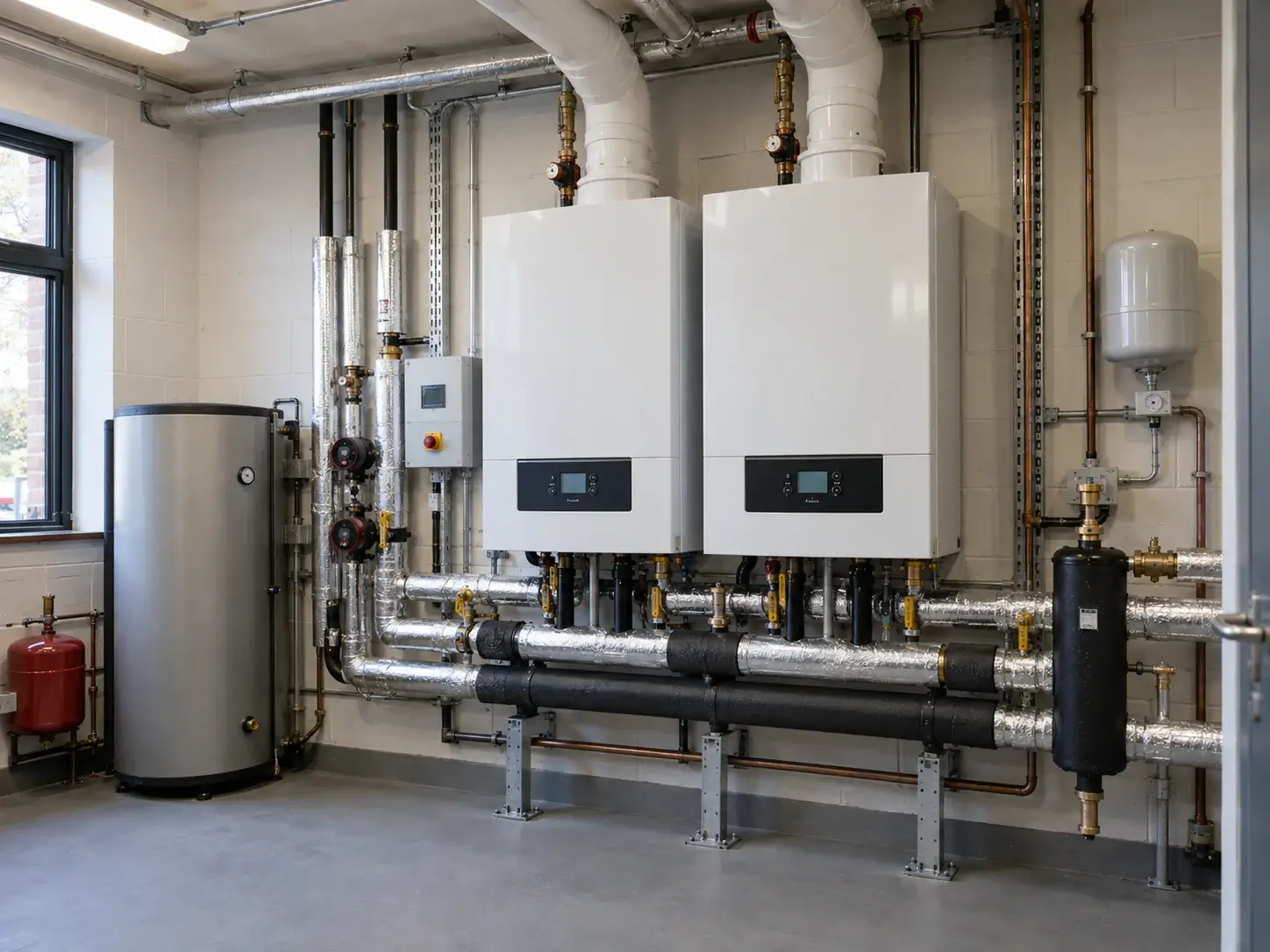
- Commercial boiler replacements typically cost £200 to £250 per kW of output, before VAT.
- A modern condensing commercial gas boiler can hit efficiencies of 98%, compared with 60 to 80% for ageing, non-condensing boilers.
- Everything from your energy usage to your building's size, storage space and fuel availability will affect the system you choose and the price you pay.
Keeping your boiler at peak efficiency is not just about keeping your building warm. It is crucial for keeping costs under control and ensuring business continuity.
The British Chamber of Commerce reports that 27% of businesses are currently struggling to pay their energy bills. For manufacturers and B2C services, that percentage is even higher.
Buying a new commercial boiler can put less pressure on your budget and place you in a stronger position in the years ahead. Whether you are running an office block, a hotel or a factory floor, this guide covers system types, costs, savings and more, to help you find the right commercial boiler for your business at the right price.
What is a commercial boiler?
A commercial boiler does the same job as your home boiler. It burns fuel, or uses electricity, to heat water for your building's radiators and taps. But there is one pretty big difference: scale.
Commercial boilers are larger, more durable and more powerful, with outputs that can easily exceed 100kW. Rather than heating a three-bed home for a family of four, they could be running round-the-clock manufacturing operations, busy food production lines, or hotels and university halls with hundreds of people needing heat and hot water.
Why UK businesses are making the upgrade
New commercial boiler installation is a strategic decision, driven by price spikes, regulation, and the risk of an unexpected failure causing major business disruption.
Rising, volatile energy prices
UK businesses, unlike UK households, do not have the Ofgem price cap protecting them from climbing energy prices. Commercial gas and electricity rates scale with the wholesale market, which can quickly swing prices from manageable to extortionate.
As of 2026, UK businesses pay on average 9.9p to 11.1p per kWh for gas. Domestic gas prices are currently capped at 7.33p per kWh.
Heating and cooling account for 40 to 60% of business energy consumption in the UK, making it one of your largest operating overheads. Energy-efficient boilers waste less energy, cutting costs to help you combat energy price spikes.
Carbon emissions, and compliance
Whether or not you believe your business has an obligation to practise environmental responsibility is not entirely up to you.
Under the Streamlined Energy and Carbon Reporting (SECR) rules, large UK companies must report their energy usage and greenhouse gas emissions every year. And, crucially, what they are doing to reduce it.
That disclosure holds you accountable, clearly spotlighting where your business is wasting energy and the actions you can take to improve it.
Reliability and business continuity
The older a boiler is, the less reliable and efficient it becomes.
For a retail store or office, a breakdown or inconsistent heating might just mean chilly customers or disgruntled staff. For a hotel, laundrette or factory, it could mean cancelled bookings or halted production. And for hospitals or care homes, the consequences are far more serious.
Most businesses simply cannot manage without heating and hot water. Modern systems are designed for dependable, consistent performance. They power day-to-day operations with less risk of unexpected breakdowns, and with 90% efficiency as standard, they stop your bill inflating past your budget.
Commercial boiler types: what to choose in 2026
Picking the wrong type of boiler for your business is a common, and expensive, mistake. Online advice about commercial boilers tends to focus on heavy industrial plant or steam-raising equipment, like water-tube and fire-tube boilers.
Instead, here are the commercial boiler types you will actually find powering offices, shops, hotels, schools and the like, from small to large.
Commercial gas boilers
Commercial gas boilers are the go-to for high efficiency, reliability and output, suiting small-to-medium sized business facilities.
They work by burning natural gases in a combustion chamber, producing hot thermal energy that is transferred across an extensive network of pipes. That heat delivers hot water to radiators, taps and heating systems throughout your building.
The condensing part means the boiler can recover heat that would otherwise be lost in a non-condensing system, maximising efficiency to 90% and above. Every commercial gas boiler sold in the UK today has to be a condensing unit, so whatever setup you choose, your boiler will always operate at high efficiency.
There are three main types of gas boiler: combi, system and regular.
Combi boilers do exist in commercial form, but they are not typically suitable for businesses because they cannot meet high hot water demands. They can be a good option for micro-businesses.
System boilers are the standard for commercial properties. They store large volumes of hot water in storage cylinders, rapidly serving multiple restrooms, taps, showers and other systems simultaneously.
Regular boilers are also in use in commercial buildings in the UK, though typically only when replacing an old legacy setup or working around niche structural constraints. They can be a good fit for larger buildings with very low water pressure, high hot water demands, and space for the bulky storage tank.
A commercial gas boiler might be best for you if:
- Your business has multiple bathrooms drawing hot water simultaneously, such as leisure centres, gyms, schools and hotels
- Your business has high hot water usage, such as salons, laundrettes and commercial kitchens
Electric commercial boilers
For businesses chasing net zero and peak energy efficiency, commercial electric boilers deliver. They heat water using electrical elements, which means no flue, no combustion and a drastically lower carbon footprint. With an average efficiency rating near 100%, they minimise energy waste, keeping your building warmer for less money.
The downside is that your business becomes more reliant on volatile electricity tariffs. In the latest GOV.UK reports, businesses were paying an average of 24.14p per kWh for electricity. For gas, the rate is much lower, at about 5.17p per kWh.
To put that into perspective, a small business will spend around £2,890 a year on electricity and £1,884 on gas if it is running a gas boiler. So your energy bills are at risk of scaling if you remove gas from the equation.
That said, for smaller businesses with lower heating demands, and those generating their own electricity via solar panels, electric boilers are capable of huge long-term savings.
Electric commercial boilers are best for:
- Small-to-medium businesses with low heating demand
- Businesses with solar panels that can offset electricity costs
- Highly insulated buildings
- Businesses operating during off-peak periods, on time-of-use tariffs
Commercial biomass boilers
For businesses off the grid, commercial biomass boilers offer low-carbon heating while letting you sidestep the volatile, high prices of gas, electricity and oil. Instead of fossil fuels, they burn sustainable fuels like wood pellets, chips and logs.
The catch? They are very high maintenance, need a lot of space, and cost considerably more than other boiler types. Though it is worth noting that biomass is the only boiler type you can currently get government funding for.
Biomass boilers are best for:
- Rural, off-grid businesses, such as farms and agricultural businesses
- Businesses with the space for fuel storage
Commercial boilers can also be set up in different ways depending on need. There are two main options: wall-hung cascade, and floor-standing.
Wall-hung cascade boilers
This is the most-used option for UK businesses today. Rather than a single boiler, several boilers are wall-mounted in a group, known as a cascade. Each boiler can operate anywhere from 30 to 150kW and beyond.
They share the workload, firing up and powering down based on demand, which suits businesses with fluctuating demand through the day. It also provides a failsafe: if one boiler breaks or needs a service, the others pick up the slack and keep your building heated.
Floor-standing boilers
These are larger and heavier, but a lot more powerful. They can exceed 1,000kW, making them ideal for high heating capacity and round-the-clock operation.
The problem is that if your boiler breaks, you have no heating or hot water until it is fixed, unless you have a second floor-standing unit. So they are generally not recommended where redundancy is vital, such as hospitals or care homes.
How much do commercial boilers cost?
Commercial boiler pricing has a much wider spread than domestic pricing. A commercial boiler could be heating anything from a small retail store to a full industrial plant room. Smaller businesses with low heating needs could get by on a 50kW boiler, whereas a larger business might need anywhere from 150kW to 500kW of capacity.
Typically, commercial boiler replacement costs around £200 to £250 per kW of output. That means you could expect to pay anywhere from £8,000 for a simple like-for-like replacement in a smaller building, to over £50,000 for a larger or multi-boiler system. Costs can swing well under, and over, these guideline prices.
A few other things worth knowing:
- For commercial biomass boilers, you are looking at an average of £55,000 to £65,000 for a standard 100kW system, fully installed, with a payback period of 4 to 8 years
- A like-for-like replacement has the lowest cost. Changing your boiler type, fuel, output or location all scale costs, along with install complexity, site access and boiler control upgrades
- A commercial condensing gas boiler should pay back within 3 to 9 years, though this is largely driven by how many hours a year the system runs
The best way to find your commercial boiler cost is a proper site survey from a qualified installer. They can give you a no-obligation quote for your commercial property that is tailored to your requirements.
Boiler ROI: what are the savings and payback really like?
There is no recent official figure for commercial boiler ROI, unlike domestic boilers, where average annual savings of £350 are widely cited.
However, the Government's SME Guide to Energy Efficiency has put a figure on it before, estimating that businesses could reduce gas bills by 10 to 30% by changing their boiler. It is dated, but it still aligns with recent domestic savings, and it has the potential to scale depending on how much you are overspending on fuel in the first place, as well as what you are upgrading to.
The payback period of a new commercial boiler averages around 3 to 9 years, less if you add smart controls. With commercial boilers having an average life expectancy of 15 to 20 years, your boiler could be paying for itself well within the halfway mark.
In honesty, commercial boiler ROI has a huge range of possibilities depending on your actual usage, current efficiency, tariff, and choice of boiler type, fuel, output and controls. With so many factors swinging the exact savings, you should always treat any figure given to you as a starting point for a conversation, not a guarantee.
Industries that benefit from commercial boiler replacements
If you have a commercial building, you need an energy-efficient boiler. That said, some industries lean harder on their boilers than others.
Schools, university campuses and halls of residence. With so many rooms needing adequate heat, and so many students using hot water at the same time, a modern condensing boiler cascade delivers the efficiency and reliability that older boilers struggle with.
Hospitals and care homes. For any business providing patient care, compromising on reliable heating and hot water is not an option. Condensing hot water cascade systems or commercial steam boilers deliver heating and hot water 24/7 for vulnerable individuals.
Industrial. From manufacturing and machinery to aerospace and chemicals, the industrial sector needs high-output boilers for reasons beyond space heating. When powering energy-intensive operations, industrial businesses might opt for steam boilers, water-tube boilers or fire-tube boilers over condensing boilers.
Hotels. You will need to account for variable hot water demand, potentially running at all hours of the day. A small B&B could make do with a 90kW boiler, whereas a 50-bed hotel with a laundrette and restaurant might need a 350 to 500kW boiler, or a cascading multi-boiler setup.
Offices and retail. Heating and hot water needs are not quite as intensive, but energy bills remain the largest line item on the budget. Replacing an inefficient boiler with an A-rated one could save you a few hundred pounds each month.
Commercial boiler grants and tax relief
The only real government grant available to businesses right now is the Boiler Upgrade Scheme (BUS). It offers biomass boiler grants of up to £5,000 for homeowners and businesses in England and Wales.
There are other ways to lower the cost of a new commercial boiler. For some limited companies, new boilers can qualify for full expensing, a 100% deduction of the cost of new, unused qualifying plant and machinery. This cannot be an upgrade or replacement; strictly, only new boilers count. You can learn more on GOV.UK.
There is also the Annual Investment Allowance (AIA), which gives 100% tax relief on qualifying equipment, including new commercial boilers, up to £1 million per year.
How to identify the best commercial boiler for your business
Before getting a boiler quote, it helps to have answers to these questions.
What is your actual heat and hot water demand? Look closely at peak demand, such as a gym at 5.30pm or a hotel over the weekend, as this is more telling than your average usage.
How big is your building? As a general rule of thumb, allocate around 40 to 60 watts of boiler output per square metre of space.
How much redundancy do you need? A large, single boiler is cheaper and easier to maintain, but a cascade system means you still have heating and hot water in the case of a failure.
What fuel options are available? Whether or not you are connected to the mains gas grid will clarify what type of boiler is suitable.
What space and access do you have? Consider room size, flue routes and delivery access to get a realistic idea of what you can install.
How insulated is the property? If you have already fitted insulation, you can downsize your boiler, as it will not need to work as hard to keep your building warm.
The commercial boiler install process, step by step
You have decided to upgrade, but what can you expect? Here is what a typical commercial boiler install looks like.
- Evaluate your suitability. Assess your needs against the questions above, then talk to an engineer or consultant who can give practical advice on your building, current boiler system, fuel types and demand
- Finalise your budget. Do this with a realistic price range in mind, factoring in unit costs, installation costs, control upgrades and pipework requirements
- Get a proper site survey. This is the best way to pin down your actual cost. Reputable installers always survey before giving a final quote, covering boiler selection, pipework and flue routing, and control strategies
- Get a quote from a certified boiler installer. Look for Gas Safe registration, along with any other relevant industry requirements such as OFTEC for oil or HETAS for biomass. Every installer in our network is Gas Safe registered and has been vetted for commercial specialisation
- Schedule and install. Book the installation at a time that causes minimal disruption to your business. Your installer will procure your equipment, install your new boiler, and commission and certify it before handing it over
- Set up ongoing maintenance. Regular servicing protects your warranty, keeps efficiency high and prolongs the life of your boiler
Thinking about buying a new boiler for your business?
It may not be the most exciting line item in your budget, but buying a new commercial boiler has never made more financial sense as energy prices continue to rise.
With new condensing boilers reaching efficiencies of 90 to 100%, it is an investment that can reliably keep your bills low and your buildings generating enough heat and hot water to meet your day-to-day needs.
Get the sizing, type and installer right, and your boiler will quietly pay for itself. Our Gas Safe registered installers can help you find the right boiler for your business at the right price.
Ready to install?
Get a free, no-obligation quote for your commercial property from a Gas Safe registered installer vetted for commercial work.
Free and no obligation. We only share your details with the installers we match you with.
Ready to install?
Get a free, no-obligation quote for your commercial property from a Gas Safe registered installer vetted for commercial work.
Free and no obligation. We only share your details with the installers we match you with.
What the accreditations actually mean
Certification is the clearest signal you have that an installer is competent, and that you are protected if something goes wrong. Here is what each one covers.





Keep reading
Unvented cylinder: how it works, costs and who can fit one
Are heat pumps worth it? Costs, savings and who they suit in 2026
Commercial boiler types compared
The five setups you will actually find in UK offices, shops, hotels and schools.
Commercial boiler costs by output
Replacement typically runs £200 to £250 per kW of output, before VAT.
Estimated savings and payback by business size
An illustration based on current UK business gas usage and commercial gas prices.