- Solar batteries store the surplus energy generated by your solar panels, letting you use it later.
- They’re capable of reducing bills by 87% for homeowners who use lots of electricity.
- Solar battery storage costs around £9,000 on average, but smaller batteries cost considerably less.
We explore the types, benefits, costs, and the huge potential savings that solar battery storage has to offer.
If you’ve got solar panels, or you’re looking to install them, you probably want to use the electricity they generate in the evening.
First of all, it’s when you’re actually home and using your appliances. And second, it’s when electricity is at its most expensive. But because solar panels generate the bulk of their electricity around 11am to 2pm, chances are you’ll only consume around 50% of it if you’re away during the day.
Solar battery storage offers a smart solution by storing your excess energy for later use. In this guide, we’ll cover everything you need to know to help you decide whether they’re the right choice for your electricity usage, your energy bills, and your long-term savings.
What is solar battery storage?
At its core, a solar battery is simply a rechargeable battery, similar to the one in your smartphone (just much bigger). It stores the electricity that your solar panels generate during the day so that you can use it later on.
In the evenings, overnight, or on cloudy days when your solar panels aren’t at full efficiency, your solar battery is there to power your home with renewable energy.
How do solar batteries work?
Once your solar panels have finished converting sunlight into power, any electricity that you don’t use straight away will be automatically routed to the battery (instead of to the grid).
There, it will be stored until you’re ready to use it, whether that’s to run your appliances during the evenings or keep the kettle boiling during a power cut.
You can even charge some batteries within overnight tariff windows, allowing you to benefit when electricity is cheaper.
Types of solar batteries
There are three main types of solar battery, each with a distinct price tag, lifespan, energy density, and suitability for UK homes.
Lithium-ion batteries
Lithium-ion batteries, specifically lithium iron phosphate (LFP) batteries, are the front-runner for premium performance. They’re also known as LiFePO4 batteries.
Their high energy density (how much energy a battery can store compared to its weight) means that they can store more power in small spaces. They also don’t need regular maintenance and have a higher depth of discharge, making them perfect for compact, high-efficiency residential solar systems.
LFP batteries do come at a higher cost. But this is usually offset by their longer lifespans, slower self-discharge, and zero thermal runaway risk.
Along with LFP, you’ve got other lithium-ion battery chemistries, such as Lithium Nickel Manganese Cobalt Oxide (NMC), Lithium Cobalt Oxide (LCO), and a few others. These also boast high performance, but they do come at a risk of thermal runaway (fires) if they’re not installed correctly.
Pros:
- High energy density
- Long lifespan (around 10 to 12 years, or 6,000 to 10,000 charge cycles)
- Low maintenance
Cons:
- High upfront costs
- Some chemistries have an increased risk of thermal runaway (fires), but only if they’re installed poorly
Lead-acid batteries
Used since 1859, lead-acid batteries are the O.G solar storage solution. But like most older technologies, they’re rather dated.
Lead-acid batteries have a low energy density, which means they’re much heavier and bulkier than lithium-ion batteries. This isn’t ideal for home solar systems, where every square metre of space counts.
They have a lower depth of discharge (DOD). Essentially, you shouldn’t drain them below 50% to maximise safety and longevity.
The good stuff? They’re reliable. They’re recyclable. And, they have a much lower price tag than lithium-ion (although they’ll need replacing more often, which can actually up the long-term costs).
Pros:
- Lower upfront cost
- Easy to recycle
- Highly reliable
Cons:
- Low energy density
- Low depth of discharge
- High maintenance
- Shorter lifespan
- Higher long-term costs due to replacements
Flow batteries
Flow batteries are an up-and-coming tech with serious potential for maximising energy storage efficiency. They store energy in two separate liquid electrolyte tanks, allowing for simultaneous discharge.
With 100% DoD and a lifespan of around 30 years, they’re the most energy-efficient option. However, a huge downside is that they’re, well, huge. They have a very low energy density and complex mechanics, which means they’re highly unsuitable for residential use.
That said, they can absolutely work for large-scale commercial solar panel systems.
Pros:
- High depth of discharge
- Long lifespan
- Minimal fire risk
- Low maintenance
Cons:
- Very low energy density
- High upfront costs
- Unsuitable (currently) for residential use
Benefits of solar battery storage
Lower bills: Solar batteries let you use all of your own power at the price it costs to make (which is roughly zero) instead of buying it back from the grid at a lower rate. This can reduce your bills by as much as 87%.
Backup power: If there’s a power cut, the energy stored in your battery will be able to keep your fridge and freezer running, your TV on, and your home lit. It’s an underrated perk that can save your grocery budget, along with your sanity.
More tariff options: By choosing a time-of-use tariff, you can charge up on a cheap overnight or off-peak rate and use that stored power during peak hours.
Increased energy independence: The Microgeneration Certification Scheme estimates that adding battery storage can increase your self-consumption from 20 to 50% with solar panels alone to 60 to 95% with battery storage. This makes you less reliant on the grid and its volatile energy prices.
Smaller carbon footprint: The more solar power you use, the fewer fossil fuels you emit via grid power, which can save tonnes of carbon emissions per year.
Future-proofing: For those with, or looking to get, an electric vehicle or heat pump, solar batteries set you up for cheaper charging and running costs.
Solar battery prices and grants
From upfront costs to how you can save, here’s the truth about solar battery prices.
How much does a solar battery cost in the UK?
The average cost of solar battery storage systems is £9,000, according to MCS.
Most homeowners won’t pay nearly as much as that. Smaller batteries are considerably cheaper than large 15kWh systems. For the majority of households, a 2 to 10kWh battery will store all the energy you need to run your home.
Solar panels cost around £7,000 for a typical 3-bedroom home. So, a solar panel with a 5 to 10kWh battery system could cost you anywhere between £9,500 and £14,000, give or take.
We have a whole solar panel cost breakdown, so definitely check that out if you want to install both.
How much does a Tesla Powerwall 3 cost in the UK?
Tesla does not publish a fixed UK price for the Powerwall 3. It is sold and fitted through Tesla Certified Installers, and UK installers typically quote £8,500 to £12,000 fully installed. Greentech Renewables, a Tesla Certified Installer, lists a typical installed price of around £10,500 including the Backup Gateway, and Amppro Electrical puts the usual range at £8,500 to £12,000. Both prices already reflect 0% VAT, which applies to home batteries until 31 March 2027.
For that, you get one of the larger home batteries on the market. According to Tesla's datasheet, each Powerwall 3 stores 13.5kWh, has a built-in solar inverter that takes up to 20kW of panels, and comes with a 10-year warranty. Because the inverter is built in, a new solar and Powerwall system does not need a separate solar inverter, which can offset some of the cost.
13.5kWh is more than many homes need. If your household would be well served by a 5kWh to 10kWh battery, compare a Powerwall quote against smaller batteries before you decide, and ask each installer for an itemised price.
Can I get a grant for solar batteries?
The Warm Homes: Local Grant in England, along with regional grants in Scotland and Wales, may be able to fully or partially cover the cost of solar panel and battery installs for eligible households. And until March 2027, there’s 0% VAT on solar batteries.
Learn more about solar panel and battery grants.
How much could I save with a solar battery?
In short: a lot. Potentially.
According to British Gas (reported by The Guardian), households can save up to 87% on their energy bills using a 5kWh battery and a 4kW solar system on an optimal south-facing roof.
The average energy bill of a typical 3-bedroom household is £913.71* per year. So, you could potentially save an average of £794 a year, assuming that you use the energy you generate.
*Bill figures from UK energy market research, assuming an average usage of 2,700 kWh on a tariff of 26.11p unit rate, with typical standard charges. Energy prices fluctuate daily and may not reflect your own electricity bill.
However, different factors affect solar battery savings: most notably how much energy you use and how much you sell, as well as your electricity tariff.
Selling energy vs self-consumption
Consume more energy, reap more savings. The Smart Export Guarantee is great for selling your surplus energy, but bear in mind that export rates are much lower than the price you’d pay to import it (it’s currently around 3p to 15p per kWh to export, against 25p to 30p per kWh to import). Increasing your self-consumption is where the real savings lie, and what solar batteries are designed to do.
Fixed tariffs vs time-of-use tariffs
Fixed tariffs offer a standard rate, typically around 26.11p per kWh for the whole day under the Ofgem price cap. Time-of-use tariffs offer off-peak rates, and even sometimes super-off-peak / overnight rates, all typically below 10p per kWh.
This allows you to charge cheaply overnight and use the battery power during expensive peak hours (usually 4pm to 8pm). You can also use the battery power at this time to cook dinner and use appliances, saving yourself a lot of money.
So, how long will a solar battery take to pay back?
Solar battery payback periods typically land in the 8 to 13 year range. But again, it varies!
The fastest way to calculate your payback period is by dividing your total costs by how much money you’ve saved (your income).
Let’s assume you paid £10,000 for your solar panel system and battery storage. You’ve managed to save £950 a year through self-consumption and exporting (well done!).
Your payback period would be 10,000 / 950 = 10 years.
Just like savings, the payback period of solar batteries has a lot to do with how much energy you consume directly vs sell. Large families with children, people who work from home, and those with electric heating and appliances will pay back their investment much faster than small households who are away most of the day and heat their home using gas.
What size solar battery do I need?
Now for one of the most common questions we get asked: “What size solar battery do I need in the UK?”.
If your research has been diluted by U.S-centric answers, then you’re not alone. Americans typically have much bigger homes and use more electricity, which some resources use to push larger batteries (which have much higher price tags) onto homeowners.
But not us!
Based on the average energy consumption of around 2,500 to 2,700kWh a year, the typical UK homeowner should only need a 10kWh battery. If you live in a smaller home, even a 5kWh will meet your needs.
Of course, this isn’t a hard-and-fast rule. If you have EVs, electric heating, heat pumps, or are at home all day, you’ll naturally use more electricity and require a bigger battery.
A 5kWh model can power a typical British home for around six to eight hours, according to The Guardian.
Are solar batteries worth it?
Generally, yes. But some households might find them more valuable than others.
You’re out during the day: Solar panels generate the most power during the middle of the day (around 11am to 2pm, which is when many people are out at work). Adding a solar battery lets you store this energy to use later, resulting in less waste and lower bills.
You’re on a time-of-use tariff: Or, you’re planning to switch to one. Solar batteries let you take full advantage of cheap overnight rates.
You’ve got an EV or heat pump: Both require lots of electricity outside of daylight hours, so adding a battery is a wise choice.
Your SEG export rates are low: Remember, it’s more cost-effective to store power for self-use than to sell it back to the grid. If your export rates fall below 15p (which is the average), then a battery could be a good option.
How to choose the best solar battery
The right path to the best battery depends on whether you’re adding one to your existing system or starting from scratch.
If you haven’t installed solar panels yet, we have the perfect resource that walks you through solar panel installation, step-by-step.
If your system is up and ready for a battery, here’s a quick checklist of what to expect when you get in touch with an installer:
Understanding your energy use: Your installer will help you gauge your energy use, as it’s key to choosing the right-sized battery. Most homeowners are fine with 5 to 10kWh storage, but you might need more or less depending on your daily routine and needs.
Assessing your existing setup: If your solar inverter is “hybrid”, you’ll typically opt for an AC-coupled system as it can be added easily with minimal kit.
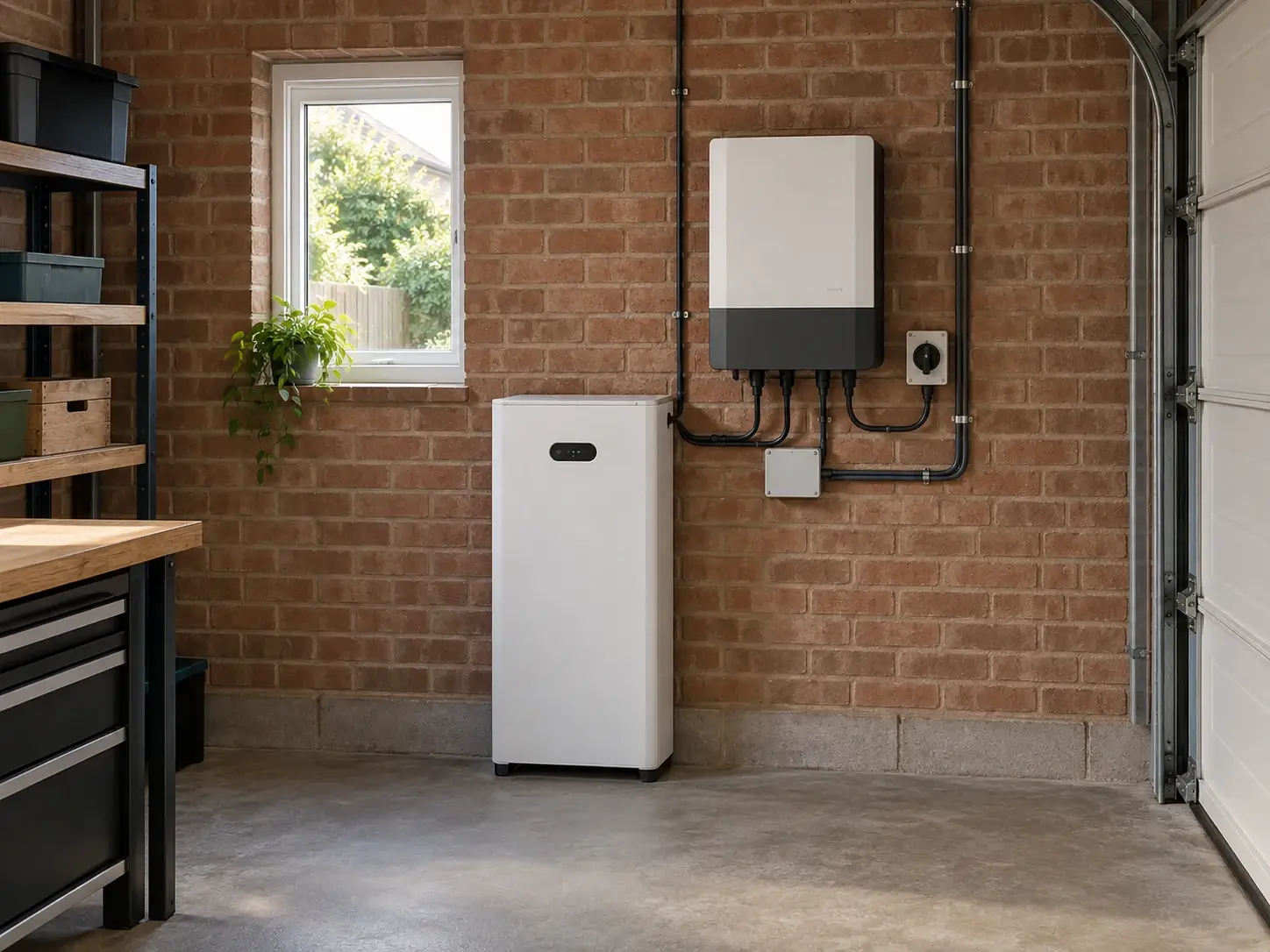
Finding the right location: UK fire safety guidance (PAS 63100:2024) specifies that batteries should be installed in well-ventilated areas, such as garages, utility rooms, or even a purpose-built external unit. So, your loft, bedroom, hallway, and unventilated basement are out of the question.
Getting a professional install: Your install should be carried out by an MCS-certified installer with up-to-date electrical safety credentials. If you need help, we can source a pre-vetted installer in your local area who can give you a free solar battery quote (with no obligation), along with a safe, high-quality install.
Is solar battery storage right for you?
Solar battery storage has gone from “nice-to-have-but-not-essential” to “almost as important as the solar panels themselves”. It makes genuine financial sense to use as much of the electricity you generate as you can to accelerate payback and take control of your energy costs.
Whether you’re ready to get a solar battery quote or are deciding whether to install a solar system with a battery, we’re here to help. Explore our solar panel hub to see how you can turn sunny days into lower bills.
Want to add a solar battery to your system?
Get a free solar battery quote from a pre-vetted, MCS-certified installer in your local area. No obligation.
Free and no obligation. We only share your details with the installers we match you with.
Want to add a solar battery to your system?
Get a free solar battery quote from a pre-vetted, MCS-certified installer in your local area. No obligation.
Free and no obligation. We only share your details with the installers we match you with.
What the accreditations actually mean
Certification is the clearest signal you have that an installer is competent, and that you are protected if something goes wrong. Here is what each one covers.





Keep reading
How long do solar panels last? Lifespan, warranties and upkeep