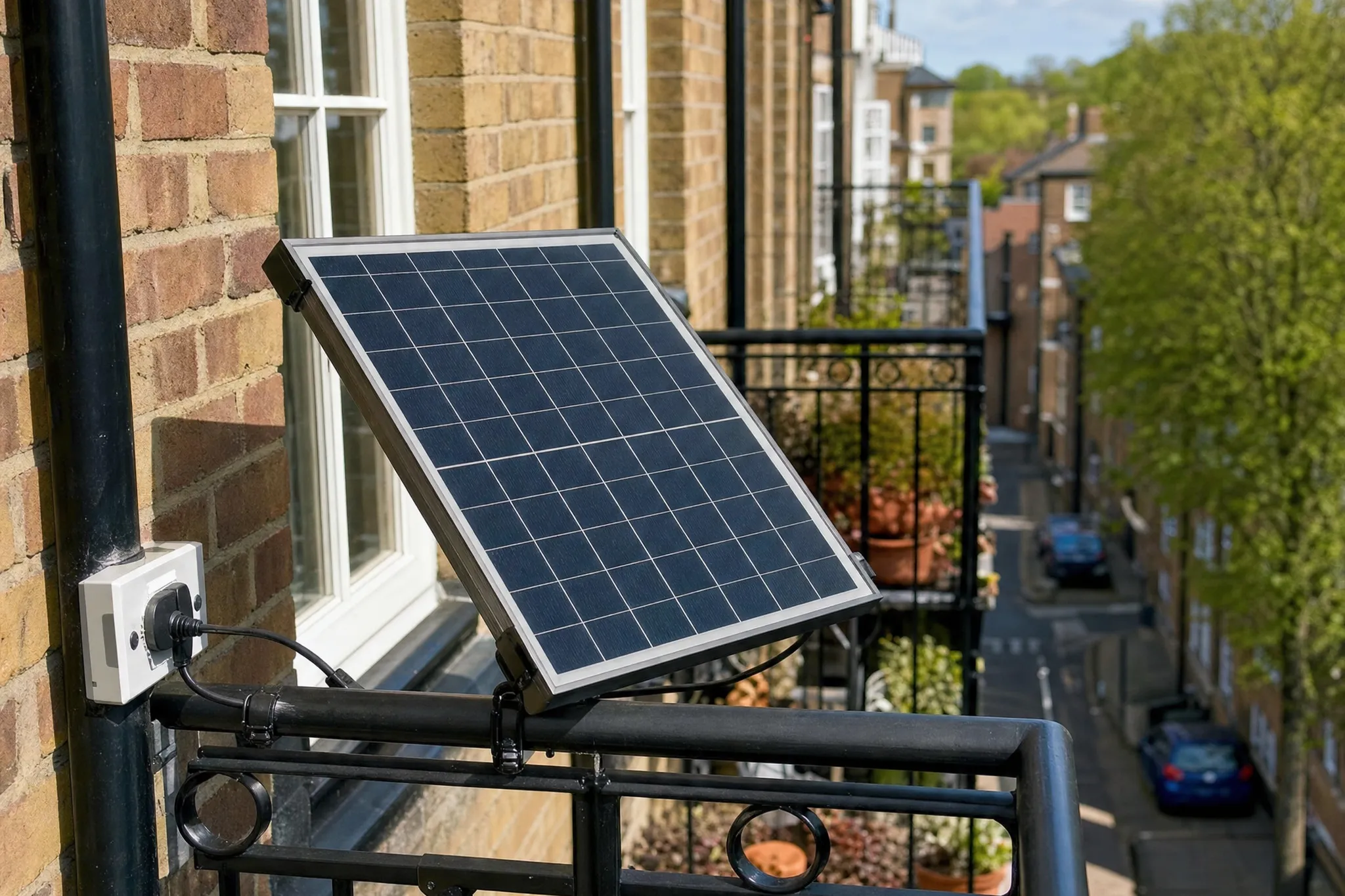
- Plug-in solar kits of up to 800W have been legal in England, Scotland and Wales since 27 August 2026. They are not permitted in Northern Ireland.
- Approved kits cost from around £450, and the government says one could save up to £110 a year. Most homes will save less.
- You can have one kit per home, and you must register it at myplugin.solar before you use it.
- Check the exact model is on the UK device register, get any permission you need, and never plug it into an extension lead.
- If you own a house with a suitable roof, rooftop solar saves far more.
Since 27 August 2026, you can buy a small solar panel kit, fix it to a balcony, wall or garden, and plug it straight into an ordinary socket. Plug-in solar panels are legal in England, Scotland and Wales, they cost from around £450, and the government says one could save a household up to £110 a year.
That makes them the cheapest way into solar power, and for many renters and flat owners, the only way. But a plug-in kit is a very different product from a rooftop system, and a few checks before you buy decide whether it is safe, legal and worth the money. This guide covers all of them.
What is a plug-in solar panel?
A plug-in solar panel, also called balcony solar or plug-and-play solar, is a small, self-contained solar kit designed for you to set up yourself. A typical kit has one or two panels, a small device called a microinverter, mounting brackets and a cable with a standard three-pin UK plug.
It works like this:
- Daylight hits the panel, which turns it into direct current (DC) electricity.
- The microinverter converts that into the alternating current (AC) your home uses.
- You plug the kit into a socket, and the electricity flows into your home's wiring.
- Anything switched on at that moment, such as the fridge, the router or a laptop, uses the solar power first, so you buy less from the grid.
Each kit is limited to 800W. The Department for Energy Security and Net Zero says that is enough to run a typical fridge, television, Wi-Fi router, laptop and phone charger at once when the sun is shining, and to provide up to 20% of an average home's electricity.
How much do plug-in solar panels cost?
The Energy Saving Trust says kits that meet UK regulations cost from around £450. That price normally includes the panels, the microinverter, mounting brackets and cables. There is no installation charge, because the kit is designed for you to set up yourself.
Prices vary with the size of the kit, the quality of the mounting hardware and where you buy it. Amazon, Argos, Currys and Wickes are among the retailers the government lists as committed to stocking them. Whatever the price, the first thing to check is that the exact model is approved for UK use, which we cover below.
How much can a plug-in solar panel save?
The government's figure is up to £110 a year. Treat that as a ceiling rather than a typical result. What you actually save depends on three things:
- Where the panel faces. A south-facing, unshaded spot generates the most. A panel hung vertically on a balcony railing, or shaded for part of the day, makes noticeably less.
- How much you use while it is generating. A plug-in kit has no battery. Power you do not use at the moment it is made flows out to the grid, and you are not paid for it under the plug-in rules.
- Your electricity price. Every unit of solar power you use saves you whatever you would have paid for that unit from the grid.
So the households that save most are the ones with appliances running through the day: a fridge and freezer, someone working from home, a dishwasher or washing machine set to run around midday.
A worked example
This is an illustration, not a forecast. Say a kit costing £450 generates 500 kWh in a year on a sunny balcony, and the household uses 70% of that as it is made.
- Solar power used in the home: 70% of 500 kWh is 350 kWh.
- Value at 25p per kWh: 350 × £0.25 is about £88 a year.
- Simple payback: £450 ÷ £88 is just over five years.
A household out at work all day might use only half of what the kit makes, which cuts the saving to around £60 a year and stretches the payback towards eight years. Moving washing and dishwasher cycles into the middle of the day is the cheapest way to improve the numbers.
Plug-in solar or rooftop solar?
They do the same job at very different scales. This is how they compare:
{{table:solar-plug-in-vs-rooftop}}
The government's own comparison is up to £110 a year from plug-in solar against up to £480 a year from rooftop panels. If you own a house with a decent roof and plan to stay, rooftop solar is still the bigger saving by a wide margin. Our guide to how many solar panels you need shows how a rooftop system is sized, and our solar panel costs page sets out what a typical installation involves.
Who are plug-in solar panels best for?
A plug-in kit makes the most sense if you:
- rent your home, or live in a flat with no roof of your own, and have permission to fit one
- have a south, south-east or south-west facing balcony, wall or garden that gets sun for most of the day
- use a steady amount of electricity during daylight hours
- want to start small, or cannot spend several thousand pounds on a rooftop system
- might move, since a plug-in kit can come with you
It makes less sense if your only outdoor space is shaded, if nobody is home and nothing much runs during the day, or if you own a house with a suitable roof. In that last case, the same money is often better put towards a rooftop system, especially while installing solar panels carries 0% VAT until 31 March 2027.
Checks to make before you buy
The rules are short, but they are rules, not suggestions. Work through these before you spend anything.
1. Make sure the kit is approved for UK use
Buy an all-in-one kit with a three-pin UK plug and a UKCA mark, made to the government's interim product specification for plug-in solar. Compliant devices are listed on the Energy Networks Association's device register, so search for the exact make and model before you buy. If a kit is not on the register, do not buy it, however cheap it is.
2. Check you are allowed to fit it
- Renting or leasehold: get permission from your landlord, freeholder or managing agent first.
- England: a new permitted development right makes it easier to fit plug-in solar to houses without planning permission. Listed buildings and conservation areas can still need consent.
- Scotland and Wales: planning rules are set separately, so check the requirements where you live.
- Northern Ireland: plug-in solar panels are not currently permitted.
3. Check your home's wiring
The Energy Saving Trust's checklist is clear that if your consumer unit (fuse box) still uses older-style fuses, you should not install plug-in solar. The type of residual current device (RCD) protecting the circuit matters too, and kit makers are expected to explain how to identify and test yours. If you are unsure about the condition of your wiring, ask a qualified electrician to look before you plug anything in.
4. One kit per home
You can have one plug-in device per home. That device can include more than one panel, but you cannot plug in a second kit or join two kits together.
5. Register it before you use it
Registering your plug-in solar panel is a legal requirement, and it lets the local network operator know the device is there. You register at myplugin.solar with your name, postcode and the make and model of the device.
Where to put a plug-in solar panel
Position decides most of your saving, so it is worth taking time over:
- Face it south if you can. South-east and south-west also work well. North-facing spots generate very little.
- Avoid shade. Watch the spot across a day before you fix anything. Shade from a building, tree or balcony above cuts output sharply, and it gets worse in winter when the sun is low.
- Tilt it if the mounting allows. A panel tilted back towards the sun usually generates more across a year than one hanging flat against a railing.
- Fix it securely. Use the brackets supplied for your balcony, wall or ground, follow the maker's instructions exactly, and never fix a panel where it could fall onto a path or a neighbour's property.
How to set one up safely
- Read the manufacturer's instructions in full before you start.
- Fix the panel and microinverter in position using the supplied mounting kit.
- Plug the kit directly into a wall socket. Never use an extension lead or a multi-socket adaptor.
- Check the kit's app or display to confirm it is generating.
- Register the device at myplugin.solar if you have not already.
- Check the cable, plug and fixings every few months, and after storms.
Where to go next
- Have your own roof? Read our solar panel buying guide.
- Work out what a rooftop system would look like with our guide to how many solar panels you need.
- Ready to compare installers? Use our nine checks for choosing a solar panel installer.
- Read the news of the rule change that made plug-in solar legal.
Common questions
Are plug-in solar panels legal in the UK?
They have been legal in England, Scotland and Wales since 27 August 2026, as long as the kit meets the UK product specification and you register it. They are not currently permitted in Northern Ireland.
Do I need an electrician to install a plug-in solar panel?
No, compliant kits are designed for you to set up yourself. You should ask an electrician to check first if your fuse box uses older-style fuses or you are unsure about your wiring.
Can I have more than one plug-in solar panel?
You can have one plug-in device per home. A single device can include more than one panel, up to the 800W limit.
Can I add a battery to a plug-in solar panel?
The plug-in rules cover the panel kit on its own. Plug-in batteries are outside them, so do not connect one to your kit. If you want storage, a rooftop system with a battery fitted by a certified installer is the route to look at. Our solar battery storage guide explains how that works.
Will I get paid for electricity I export?
The plug-in rules do not set up export payments. Rooftop systems fitted by an MCS-certified installer can earn Smart Export Guarantee payments. The Energy Saving Trust notes that some suppliers may offer export tariffs without an MCS certificate, so it is worth asking yours.
Do plug-in solar panels work on cloudy days?
Yes, at a lower output. Solar panels generate from daylight rather than direct sun, so they keep working on overcast days and through winter, just producing less.
Can I take a plug-in solar panel with me when I move?
Yes. Because it plugs into a socket rather than being wired in, a plug-in kit can move with you. Register it again at your new address.
Sources
- Department for Energy Security and Net Zero, Households can save as plug-in solar panels come to market, published 26 August 2026. Checked 11 November 2026.
- Energy Saving Trust, Plug-in solar panels. Checked 11 November 2026.
- Energy Saving Trust, Plug-in solar panels: checks to make before you buy, updated 27 August 2026. Checked 11 November 2026.
- UK Plug-in Solar Registration. Checked 11 November 2026.
- Ofgem, Smart Export Guarantee. Checked 11 November 2026.
Got a roof that could do more?
A rooftop system can save several times what a plug-in kit does. Tell us your postcode for a free, no-obligation quote from an MCS-certified installer.
Free and no obligation. We only share your details with the installers we match you with.
Keep reading
How long do solar panels last? Lifespan, warranties and upkeep
How to choose a solar panel installer: 9 checks before you sign
Plug-in and rooftop solar compared
How a self-fitted plug-in kit compares with a professionally installed rooftop system on size, cost, savings and rules.