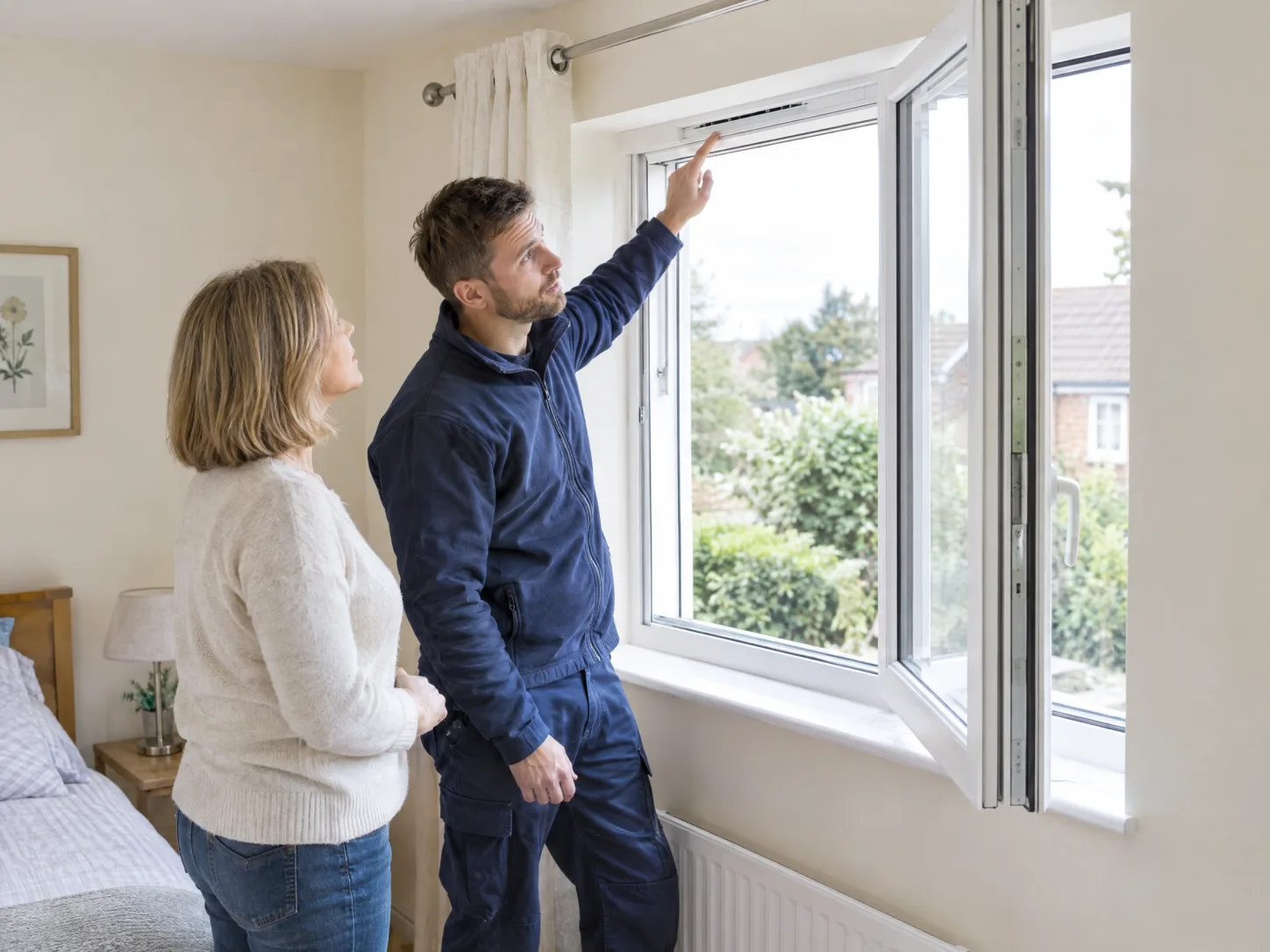
- In England and Wales, replacement windows need sign-off by a registered installer or by building control.
- FENSA is one of six approved schemes in England, and its certificate covers England and Wales only.
- New windows must keep or add trickle vents, keep escape routes and use safety glass where needed.
- Scotland and Northern Ireland need no application for like-for-like windows, but the rules still apply.
- A FENSA-registered installer must register the work within 21 days of finishing it.
Before new windows go in, agree who will sign the work off, check whether you need planning or listed building consent, and make sure the new windows keep the ventilation, fire escape routes and safety glass the rules require. Afterwards, in England and Wales, expect a certificate from the installer's scheme, usually FENSA, within a few weeks.
This checklist covers everything except energy performance, which is in window energy ratings and U-values. For prices, see window and door costs.
Step 1: check the permissions
Replacing windows with similar-looking ones does not usually need planning permission, but three things can change that:
- Listed buildings: consent is needed for work that affects a listed building's character, in every nation.
- Conservation areas and Article 4 directions: your council can remove the usual rights, so check before you order.
- Flats and leaseholds: your lease may require the freeholder's agreement, and in England flats do not have the same permitted development rights as houses.
In Scotland, the national rules allow replacement windows without planning permission, except in World Heritage Sites, with extra limits in conservation areas. In Wales and Northern Ireland, permission is not normally needed for like-for-like windows, but check with the council for listed buildings and designated areas.
Step 2: choose who signs the work off
In England and Wales, the building regulations have applied to replacement windows since April 2002. The work must either be done by an installer registered with a government-approved scheme, who can certify it themselves, or be checked by building control.
In England, six schemes are approved for replacement windows as of September 2026: Blue Flame Certification, CERTASS, Certsure, FENSA, NAPIT and ASSURE. FENSA is one of them, not the only route.
In Scotland, replacing a window, frame and all, needs no building warrant, but the work must still meet the building standards. In Northern Ireland, no building control application is needed, but the regulations still apply.
Step 3: the survey and the quote
A good survey measures every opening and checks what each window must do, not just its size:
- the whole-window U-value and energy rating for each window;
- trickle vents, sized to the rules;
- which windows are fire escape routes;
- which panes need safety glass;
- the frame, the opening style and the hardware;
- how any deposit is protected, and what guarantee comes with the work.
Citizens Advice warns that windows made to your measurements may not come with an automatic cooling-off period, so read the contract before you sign.
Step 4: the rules besides energy
Replacement windows have to meet several rules at once. The table sets out the main ones.
Trickle vents. If your old windows had background ventilators, the new ones must have vents at least as large, which you can open and close. If they had none, England's rules give one accepted way to keep the ventilation right: vents of at least 8,000 square millimetres in each habitable room and kitchen, and 4,000 in each bathroom.
Escape windows. A replacement must be at least as good an escape route as the window it replaces. For a new escape window in England, that means an opening of at least 0.33 square metres, at least 450mm high and wide, with its bottom no more than 1,100mm above the floor.
Safety glass. Glazing within 800mm of the floor, and in and beside doors up to 1,500mm, must be safety glass in England.
A worked example: vents and an escape window
Take a three-bedroom semi in England whose old windows had no trickle vents. It has five habitable rooms, a kitchen and a bathroom.
- Vents: 5 × 8,000 + 8,000 + 4,000 = 52,000 square millimetres across the new windows. In Northern Ireland, the equivalent would be 5 × 5,000 + 2,500 + 2,500 = 30,000.
- The bedroom escape window: a clear opening of 450mm by 750mm is 0.3375 square metres, which passes. At 450mm by 700mm, it is 0.315 square metres, which fails.
Ask your surveyor to show you the vent and escape figures for your windows before you sign.
Step 5: the certificate, and what if it never arrives
A FENSA-registered installer must register the job within 21 days of finishing it, and FENSA says the certificate is usually issued within 15 days after that. So allow about five weeks from the end of the job.
If it does not arrive:
- ask the installer to register the work;
- if they will not, contact the scheme;
- FENSA can only register installations from the last two years, so after that, ask your council's building control about regularisation, a retrospective check;
- a lost certificate can be replaced: FENSA charges £30 for a copy.
FENSA also says no one can hold your certificate back to make you pay, and it warns against indemnity insurance offered instead of a certificate. Keep the certificate with the house deeds.
{{accreditations}}
Watch out for these
- An installer who never registers the work. Without a certificate you may need a building control inspection later, at your own cost.
- A certificate held back until you pay. FENSA says this is not allowed.
- Indemnity insurance instead of a certificate. FENSA advises against it.
- Missing guarantees. FENSA work must come with an insurance-backed guarantee, which protects you if the installer stops trading.
- Doorstep callers who will not leave. Ignoring a request to leave is a banned sales practice. Report scams to Report Fraud on 0300 123 2040, or to Police Scotland on 101.
How it differs across the UK
- England: six approved schemes, or building control; retrospective regularisation for work done without it.
- Wales: replacement windows need sign-off too, and FENSA covers Wales.
- Scotland: no building warrant for a like-for-like replacement, and no FENSA; the work must still meet the building standards, including ventilation and safety.
- Northern Ireland: no building control application for replacement windows; the rules still apply, with trickle vents of 5,000 square millimetres in habitable rooms and 2,500 in kitchens, utility rooms and bathrooms.
- Security: England's rules on security, Approved Document Q, apply to new homes only, not replacement windows.
Where to go next
- Check the energy limits in window energy ratings and U-values.
- Compare glazing in Double or triple glazing?
- See prices and what a quote covers on window and door costs.
- Choose frames and styles in our windows and doors buying guide and on windows and doors.
- Check help on grants, or start from our windows and doors overview.
Ready to replace your windows properly?
Tell us about your home to get a free, no-obligation quote from a FENSA or Certass registered installer, then use this checklist to agree vents, escape windows and the certificate before work starts.
Free and no obligation. We only share your details with the installers we match you with.
Common questions
Is a FENSA certificate a legal requirement?
Not FENSA itself, but in England and Wales the work must be certified by a registered installer from an approved scheme or checked by building control. FENSA is one of the schemes.
Do replacement windows need trickle vents?
If the old windows had them, yes, at least as large. If not, England's rules expect the ventilation to be kept at least as good, and vents in the new windows are the usual way.
Can I sell a house without a FENSA certificate?
You can, but a buyer's solicitor will usually ask for it. Without one, a regularisation certificate from building control, or a copy from the scheme, is the fix.
Do I need planning permission for new windows?
Not usually for similar-looking windows on a house. Listed buildings, conservation areas with Article 4 directions and some flats are the exceptions.
Which is better, FENSA or Certass?
Both are government-approved schemes that let installers certify their own window work in England and Wales. What matters is that your installer is registered with one of them.
Ready to replace your windows properly?
Tell us about your home to get a free, no-obligation quote from a FENSA or Certass registered installer, then use this checklist to agree vents, escape windows and the certificate before work starts.
Free and no obligation. We only share your details with the installers we match you with.
What the accreditations actually mean
Certification is the clearest signal you have that an installer is competent, and that you are protected if something goes wrong. Here is what each one covers.






Keep reading
Condensation on windows: causes and how to stop it
Window energy ratings and U-values explained
What replacement windows must meet, besides energy
Sign-off, ventilation, escape and safety glass for replacement windows, and how each nation handles them, as of September 2026.