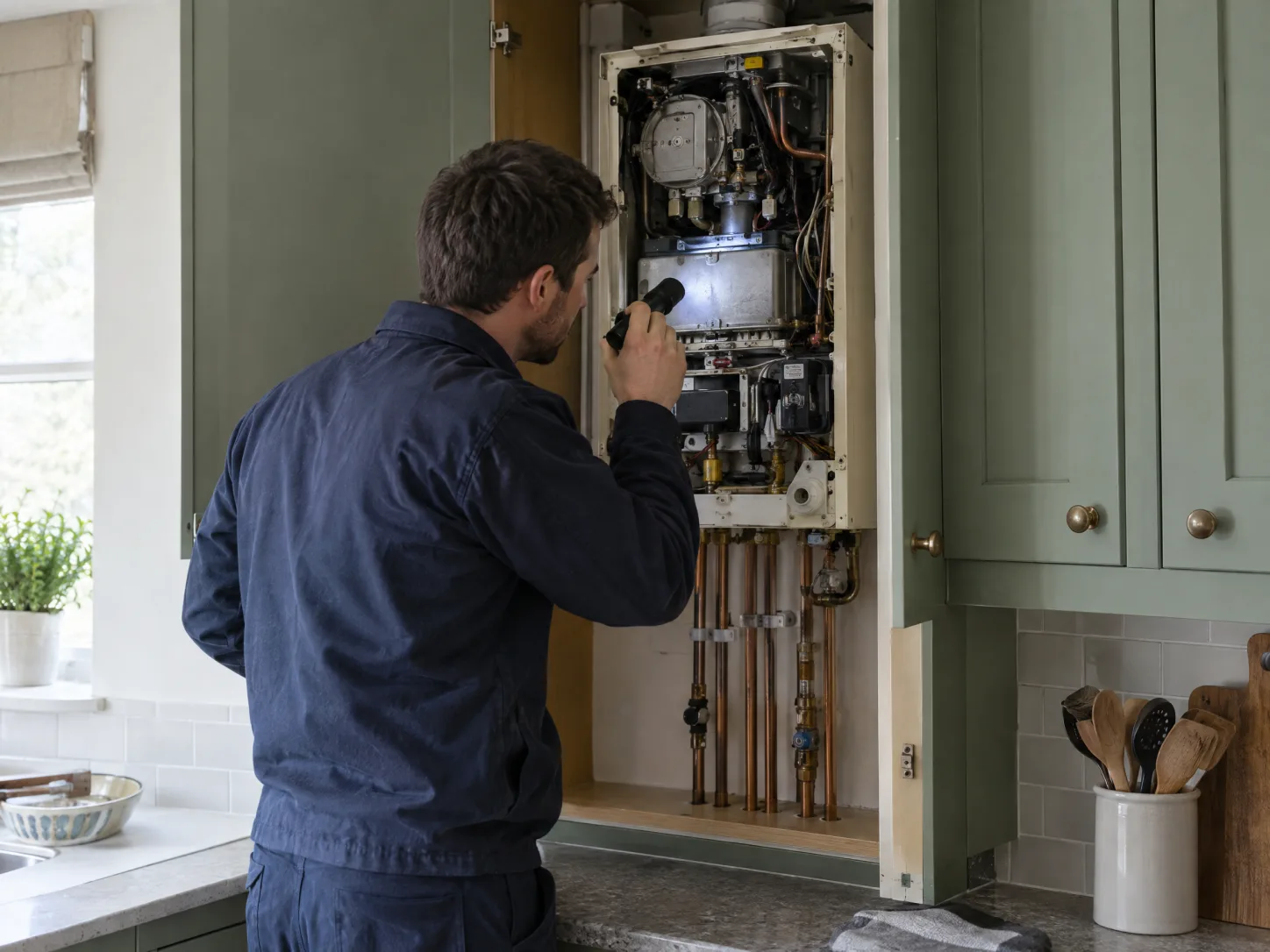
- An "Immediately Dangerous" or "At Risk" notice means stop using it; other warnings leave the choice to you.
- A new gas boiler must be at least 92% efficient in Great Britain, and 88% in Northern Ireland.
- Replacing a very old, inefficient boiler can save up to £350 a year in a typical semi.
- Measured savings from replacing a boiler that is already condensing are small, about 2% of gas.
- New heating controls fitted with the boiler add much of the saving, so ask for both.
Replace a boiler when it is unsafe, when repairs keep coming, or when it is an old non-condensing model, because that is where the savings are. If yours is a working condensing boiler, a new one usually saves little on bills, so replace it for reliability rather than to cut costs.
This guide helps you decide. For what a new boiler costs, see boiler costs, and for the choice between boiler types, see our boiler buying guide.
Is your boiler safe?
Safety comes before money. The Health and Safety Executive lists signs that a gas appliance may not be burning properly:
- yellow or orange flames instead of blue;
- soot or yellow and brown staining on or around the boiler;
- a pilot light that keeps going out;
- more condensation than usual on the inside of windows.
If you notice any of these, stop using the boiler and ask a Gas Safe registered engineer to check it. If you smell gas, call the gas emergency line: 0800 111 999 in Great Britain, or 0800 002 001 in Northern Ireland.
What do an engineer's warnings mean?
Gas Safe engineers use three categories, and only two are urgent.
- Immediately Dangerous: the installation is disconnected, with your permission, because it is a danger to life.
- At Risk: the appliance is turned off, with your permission, until the fault is fixed.
- Not to current standards: it works safely, but it would not meet today's rules if fitted now. Gas Safe says whether you act on this is "completely up to you".
So a boiler that is merely old, or "not to current standards", does not have to be replaced on the spot. Be wary of anyone who says otherwise to close a sale.
How efficient is your boiler?
Efficiency decides how much of the gas you pay for turns into heat. Find the model number on the boiler's data plate or in its manual, then look it up on the government's product database, which lists the efficiency of most boilers sold in the UK.
The labels have changed over the years, which confuses comparisons. The table decodes them.
The key point: a new gas boiler in Great Britain must be at least 92% efficient. An old boiler in band G under the old system ran below 70%, which is why replacing one saves so much. A condensing boiler in good working order is much closer to the new standard, so replacing it changes much less, as the measured savings below show.
What does a new boiler really save?
It depends almost entirely on what you are replacing. There are two sources, and they answer different questions.
- Modelled savings: the Energy Saving Trust estimates that a semi-detached home in Great Britain replacing a G-rated boiler with an A-rated one saves up to £350 a year at July 2026 prices. A detached home saves up to £500, and replacing a D-rated boiler in a semi saves about £190.
- Measured savings: DESNZ compared real gas use in England and Wales before and after new condensing boilers were fitted in 2023. The median saving was just 2.3%, about 236 kWh a year, because most homes were replacing a boiler that was already fairly efficient.
DESNZ also found that homes fitting a condensing boiler and new heating controls together saved a median 11.5% of their gas, about 1,218 kWh a year. The controls matter as much as the boiler. Our guide to new boiler regulations explains which controls are required.
A worked example: three homes, three answers
At the October to December 2026 price cap, gas costs 7.97p per kWh. The Energy Saving Trust puts a typical gas boiler replacement at about £3,500.
- A semi with a G-rated boiler: saving £350 a year. Payback: £3,500 ÷ £350 = 10 years.
- A semi with a D-rated boiler: saving £190 a year. Payback: £3,500 ÷ £190 = about 18 years.
- A home replacing a working condensing boiler: the DESNZ median of 236 kWh × 7.97p = about £19 a year. On savings alone it would never pay back; the reason to replace is reliability.
A cross-check from official inputs: a home using 9,500 kWh of gas a year needs 8,740 kWh of heat with a new 92% boiler. If the old boiler ran at 70%, it burned about 12,486 kWh for the same heat, 2,986 kWh more. At 7.97p that is about £238 a year, or about 15 years to repay £3,500. Your own figure depends on how efficient your old boiler really is.
In Northern Ireland, where more than two-thirds of homes use oil, the Energy Saving Trust puts the saving for a semi at about £290 a year against a £3,200 replacement: about 11 years.
When is replacing worth it anyway?
Money is not the only test. Replacing is usually the sensible choice when:
- the boiler has an "At Risk" or "Immediately Dangerous" fault that cannot be fixed economically;
- breakdowns are frequent and each repair costs a sizeable share of a new boiler;
- parts are no longer available for your model, which your engineer can confirm;
- you are changing the system anyway, for example moving the boiler or adding a cylinder.
If none of these apply and your boiler is condensing and reliable, a service and better controls may be the better spend for now.
Questions to ask before you replace
- Is my current boiler safe, and what exactly is wrong with it?
- What would a repair cost, and how long is that likely to last?
- What efficiency is my current boiler, and what will the new one be?
- Which controls will you fit, and do they meet the rules for my nation?
- What size boiler does my home need, and how did you work it out?
- Would a heat pump suit my home, now or later? Our guide to heat pump or gas boiler compares them.
Watch out for these
- "Condemned, buy today" pressure. A boiler that is only "not to current standards" can keep running safely. Take time to get a quote.
- Engineers who are not registered. Only Gas Safe registered engineers may work on gas boilers, and pretending to be registered is a criminal offence. Check the ID card: the back lists what each engineer is qualified to work on.
- Savings claims with no working. Ask which boiler you are replacing, and at what efficiency, before trusting a savings figure.
- Skipping safety checks. Around seven people die each year from carbon monoxide poisoning linked to gas appliances, according to HSE. Fit a carbon monoxide alarm whatever you decide.
How it differs across the UK
- Minimum efficiency: 92% for new gas boilers in England, Wales and Scotland; 88% for gas, oil and LPG boilers in Northern Ireland, measured on an older scale.
- Fuel: most Northern Ireland homes heat with oil, so the Energy Saving Trust publishes separate Northern Ireland figures.
- Help with the cost: England's Warm Homes: Local Grant does not fund gas boilers. Warmer Homes Scotland can, Nest in Wales can repair or replace a boiler in a home without heating or hot water, and Northern Ireland's Affordable Warmth Scheme can replace boilers at least 15 years old for eligible households. See how to apply for a heating grant.
- Gas emergency numbers: 0800 111 999 in Great Britain; 0800 002 001 in Northern Ireland.
Where to go next
- Compare prices and what a replacement includes on boiler costs.
- See the types on boilers and how to choose in our boiler buying guide.
- Check the rules for a new boiler in new boiler regulations.
- Look for help on boiler grants, or start from our boilers overview.
Time for a new boiler? Get a quote
Tell us about your home to get a free, no-obligation quote from a Gas Safe registered engineer, with the new boiler sized to your home and fitted with the controls the rules require.
Free and no obligation. We only share your details with the installers we match you with.
Common questions
What age should a boiler be replaced?
There is no set age. Replace on safety, reliability and efficiency. Northern Ireland's Affordable Warmth Scheme uses 15 years as one of its tests for funded replacement, but that is an eligibility rule, not a lifespan.
Is it worth replacing a 15 year old boiler?
If it is a non-condensing boiler, usually yes, because the saving is large. If it is condensing and reliable, the saving is small, so weigh the cost against repair and reliability.
How do I know if my boiler is condensing?
Most condensing boilers have a plastic condensate pipe running from the boiler to a drain. The model number on the data plate, looked up on the government's product database, confirms it.
What does "At Risk" mean on a boiler?
It means a Gas Safe engineer found a fault that could become dangerous. The appliance is turned off with your permission until it is repaired or replaced.
Will a new boiler lower my bills?
It will if your current boiler is inefficient. Replacing an old non-condensing boiler can save hundreds of pounds a year; replacing a condensing one usually saves much less.
Time for a new boiler? Get a quote
Tell us about your home to get a free, no-obligation quote from a Gas Safe registered engineer, with the new boiler sized to your home and fitted with the controls the rules require.
Free and no obligation. We only share your details with the installers we match you with.
Keep reading
Unvented cylinder: how it works, costs and who can fit one
Are heat pumps worth it? Costs, savings and who they suit in 2026
What boiler efficiency labels mean
Today's energy labels, the older bands used in savings estimates, and the legal minimum for a new boiler in each part of the UK.