- Each nation runs its own insulation funding, so start with the route for where you live.
- In England, a home rated EPC A to C cannot get the Warm Homes: Local Grant at all.
- Proof of income or benefits is checked; a signed statement of your own is not accepted.
- In Scotland and Northern Ireland, starting work before written approval loses the funding.
- A refusal usually names a rule, and knowing which one tells you what to try next.
Apply through the route for the nation you live in, then expect an eligibility check, a whole-house survey and a written decision before any work starts. Most refusals come down to four things: the EPC rating, household income, the property itself, or work that started before approval.
This guide covers the process and the refusals. For what support exists today and who each scheme is for, see insulation grants and funding, which carries the current position on every scheme and the date each was last checked.
Where do you apply?
Insulation funding is run separately in each nation, so the first step depends on where you live. As of September 2026:
- England: the Warm Homes: Local Grant, which starts with an online eligibility check on gov.uk and is then run by your council.
- Scotland: Home Energy Scotland, which handles both the Home Energy Scotland Grant and Loan and the Warmer Homes Scotland scheme.
- Wales: the Warm Homes Nest scheme, run for the Welsh Government.
- Northern Ireland: the Affordable Warmth Scheme, run by the Housing Executive through the NI Energy Advice Service.
In England, Scotland and Wales the ECO4 energy supplier scheme also runs until 31 December 2026. Ofgem stresses that it is an obligation on suppliers rather than a grant, so being eligible does not guarantee that a supplier will fund the work, and you may be asked to contribute.
What should you have ready before you apply?
Applications stall on missing paperwork more often than they fail on eligibility. The English guidance is blunt: "Self-declarations are not an acceptable method of verification." Gather these before you start:
- Your EPC. Look it up free on the government register, or the Scottish register if you live in Scotland. Some routes need a current certificate, so check its date.
- Proof of income for the household, such as recent payslips, benefit award letters or bank statements.
- Proof of ownership or tenancy, and your landlord's written agreement if you rent.
- Proof that you live there, since most schemes are for your main home only.
- Health evidence, if a condition is part of how you qualify in Wales.
Gather it once. The schemes ask for broadly the same documents, so the same folder serves any route you try.
What does the home survey look at?
If your application goes ahead, an assessor visits, and the survey decides what gets funded. In England, council schemes follow the PAS 2035 retrofit standard, which assesses the whole house: its condition, ventilation, how it is heated and how you use it.
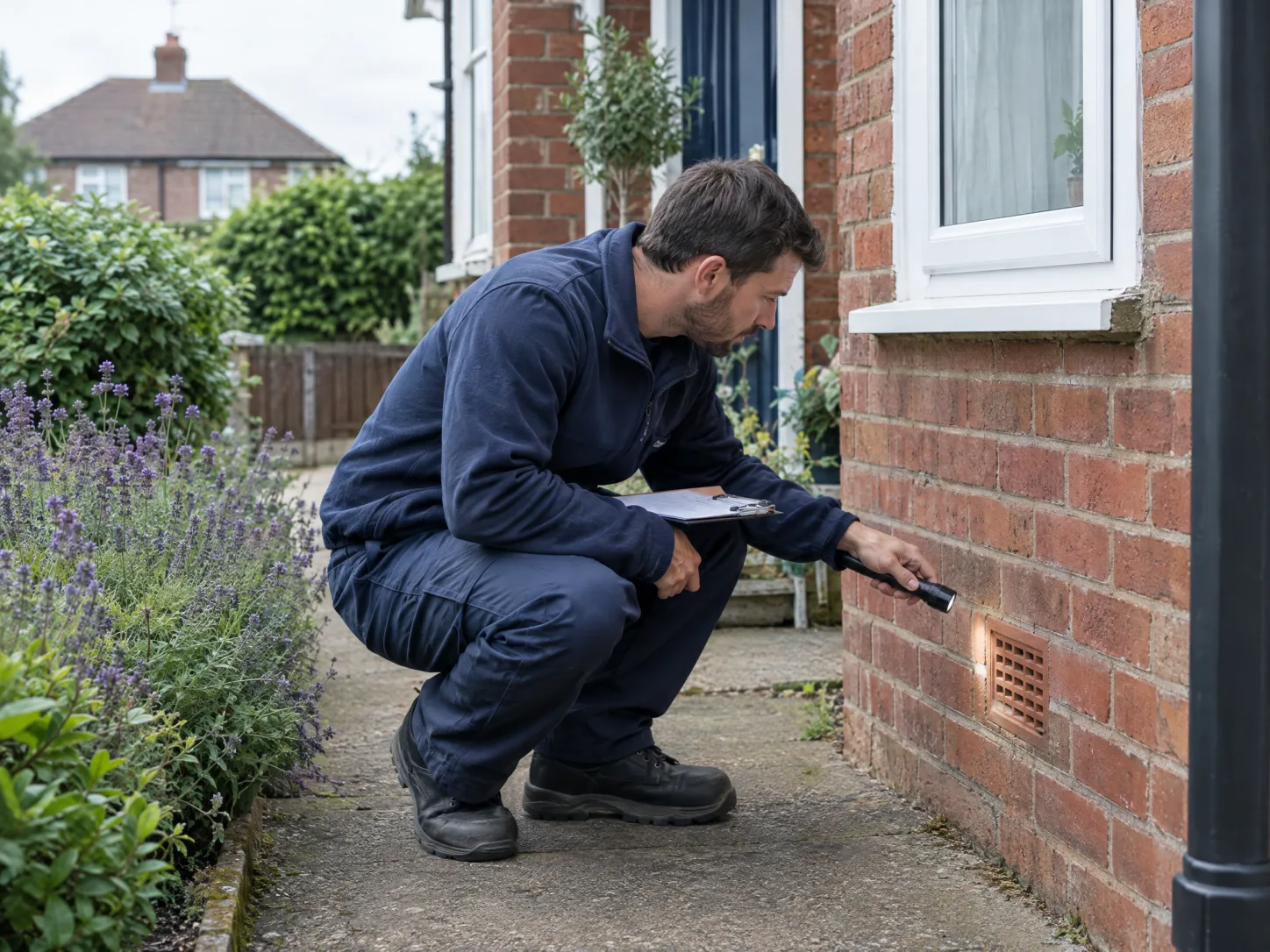
Expect the assessor to look at the loft and roof, the walls, the floor, damp, windows and the heating. In Northern Ireland the Housing Executive's technical visit can take up to an hour and, where you have cavity walls, may include a borescope check through small holes drilled in the outside wall, with your permission.
The survey can recommend something other than what you asked for. If you applied for wall insulation but the loft is empty, expect the loft first. That is the scheme working as designed, and taking the first measure usually improves your case for the next one.
Why are applications refused?
Most refusals trace back to a published rule. These are the common ones, as of September 2026.
A few need a word more:
- The EPC is too good. In England, homes rated A to C are ineligible for the Warm Homes: Local Grant "in all circumstances". In Wales, a home rated D can still qualify for Nest if someone in the household has an eligible health condition; without one, it goes on a reserve list.
- Income or evidence. The usual English limit is £36,000 a year, but there is also a route based on income after housing costs, covered in the example below.
- Savings or assets. English councils can decline a household with high savings or a particularly large asset value, even when income is under the limit.
- Work started too early. Home Energy Scotland and the Housing Executive will not pay for work started before a written offer or approval.
- Funding has run out. Council and nation schemes have fixed budgets, so a refusal can simply mean the money for this year is committed. That is a timing problem, not a permanent one.
What should you do if you are turned down?
Ask which rule decided it, because that tells you what to do next.
- Income or benefit test: check whether another route applies. In England that could be the after-housing-costs test or a qualifying postcode.
- EPC too good: a funded scheme is unlikely, but 0% VAT still applies to installing insulation until 31 March 2027.
- A property issue: some can be fixed, such as damp or missing landlord agreement, and you can reapply once they are.
- Funding committed: reapply when the next allocation opens, and ask to be kept on any waiting or reserve list.
If none of the funded routes fit, getting an itemised quote still tells you exactly what the work would cost, and the zero rate of VAT keeps that cost down for now.
A worked example: the income test after housing costs
A couple with two children in England earn £45,000 between them, which is over the usual £36,000 limit. Their home is rated EPC E.
- The Warm Homes: Local Grant guidance also allows an income test after housing costs, with a limit of £28,000 for two adults and two dependent children.
- Their net income is £37,000 and their mortgage costs £9,500 a year.
- £37,000 minus £9,500 is £27,500, which is under £28,000.
So they may still be income-eligible, subject to the council's checks on evidence, savings and funding. The household figures here are illustrative; the thresholds come from the DESNZ guidance published in 2026.
Watch out for these
- "Free insulation" cold callers. Genuine schemes do not need you to decide on the doorstep. Home Energy Scotland's terms say that neither the Scottish Government nor the Energy Saving Trust condones cold calling, and in Scotland you must apply yourself, not through an installer.
- ECO work without a contract. Ofgem advises agreeing to ECO work only once you have a written contract.
- Anyone asking for a fee to secure a grant. Check the scheme on gov.uk, gov.scot, gov.wales or nidirect before sharing any details.
- Pressure to sign at home. You normally have 14 days to cancel a contract signed at home.
- Scams to report. In England, Wales and Northern Ireland, report fraud to Report Fraud on 0300 123 2040; in Scotland, call Police Scotland on 101.
How the process differs across the UK
- England: the council contacts you, usually within 10 working days of the online check, to arrange a survey. The Warm Homes: Local Grant runs to 31 March 2028.
- Scotland: Home Energy Scotland funds only the measures an EPC recommends, and expects loft and cavity insulation first. Offers are valid for a fixed period, so plan the work before you accept.
- Wales: Nest looks at your EPC score and household income, with health conditions widening who qualifies.
- Northern Ireland: households with a gross income under £23,000 can apply to the Affordable Warmth Scheme; social housing tenants cannot. A replacement scheme, the Warm Healthy Homes Fund, has been consulted on, so check the current position.
Where to go next
- See which schemes apply to you, and when each was last checked, on insulation grants.
- Find out what the work costs on insulation costs, and what each measure involves on home insulation types.
- Decide what to do first in Is insulation worth it?
- For panels, the sister guide is how to apply for a solar grant.
- Read why ECO4 closes in December 2026, or start from our insulation overview.
See what insulating your home would cost
Whether or not you qualify for funding, you can get a free, no-obligation insulation quote from a TrustMark-registered installer, so you know the price before you decide how to pay for it.
Free and no obligation. We only share your details with the installers we match you with.
Common questions
Can I get free insulation if I rent my home?
Sometimes. Private tenants can apply to most schemes with the landlord's written agreement, and in England landlords may have to pay part of the cost. Social housing tenants are usually covered by their landlord's own programmes instead.
Do I need an EPC to apply?
For most routes, yes, because the rating decides eligibility. If your home has no certificate or an old one, the scheme or its assessor will tell you whether a new one is needed.
Can pensioners get free insulation?
Age alone does not qualify you in England. Income, benefits, the EPC rating and where you live decide it, so check the route for your nation on our grants page.
Is free insulation a con?
The government-backed schemes are genuine, but so are the scams that copy them. Start from the official route for your nation, never from a cold call, and never pay a fee to apply.
Are insulation grants still available?
Yes, as of September 2026. The Great British Insulation Scheme closed in March 2026 and ECO4 closes on 31 December 2026, but council, Scottish, Welsh and Northern Ireland schemes continue.
See what insulating your home would cost
Whether or not you qualify for funding, you can get a free, no-obligation insulation quote from a TrustMark-registered installer, so you know the price before you decide how to pay for it.
Free and no obligation. We only share your details with the installers we match you with.
Keep reading
Underfloor insulation and draught proofing: cheap fixes for a cold house
Insulation checklist: permissions, ventilation and paperwork
What each route asks for, and where it stops
Where to start in each nation, the evidence you will be asked for, and the published rules that most often end an application.