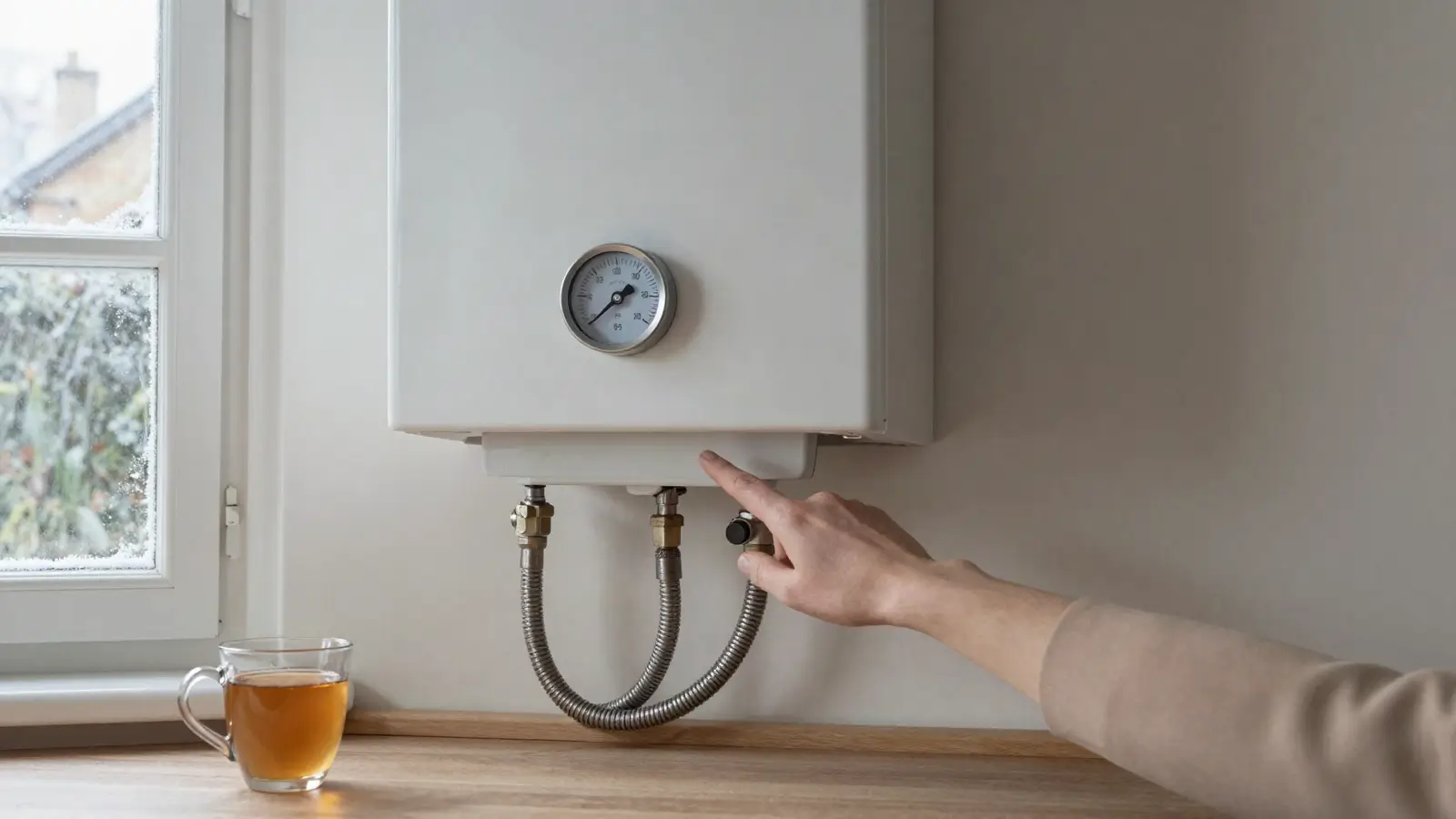
- With the boiler cool, the gauge should read between 1 and 1.5 bar.
- With the heating on, anywhere up to about 2 bar is normal, because hot water expands.
- Below 1 bar, top up through the filling loop and close it fully afterwards.
- Topping up once or twice a year is normal. Every few weeks points to a leak or a fault.
- Never open the safety valve yourself, and leave anything inside the casing to a Gas Safe registered engineer.
With the heating off and the boiler cool, your pressure gauge should read between 1 and 1.5 bar. With the heating running, anything up to about 2 bar is normal. If it has dropped below 1 bar, you can usually top it up yourself in five minutes using the filling loop under the boiler.
Low pressure is one of the most common reasons a boiler cuts out on the first cold morning of the year. The radiators stay cold, the display flashes a fault code, and it is easy to assume the worst. Most of the time the fix is simple, and this guide walks you through it.
What should my boiler pressure be?
The answer depends on whether the boiler has been running. Water expands as it heats, so the needle always sits a little higher when the heating is on.
These are typical figures. Vaillant and Baxi both put normal running pressure at 1 to 2 bar, and Worcester Bosch says 1 to 1.5 bar when the system is cool. Your manual has the exact range for your model, so check it if the two disagree.
How do I read the gauge?
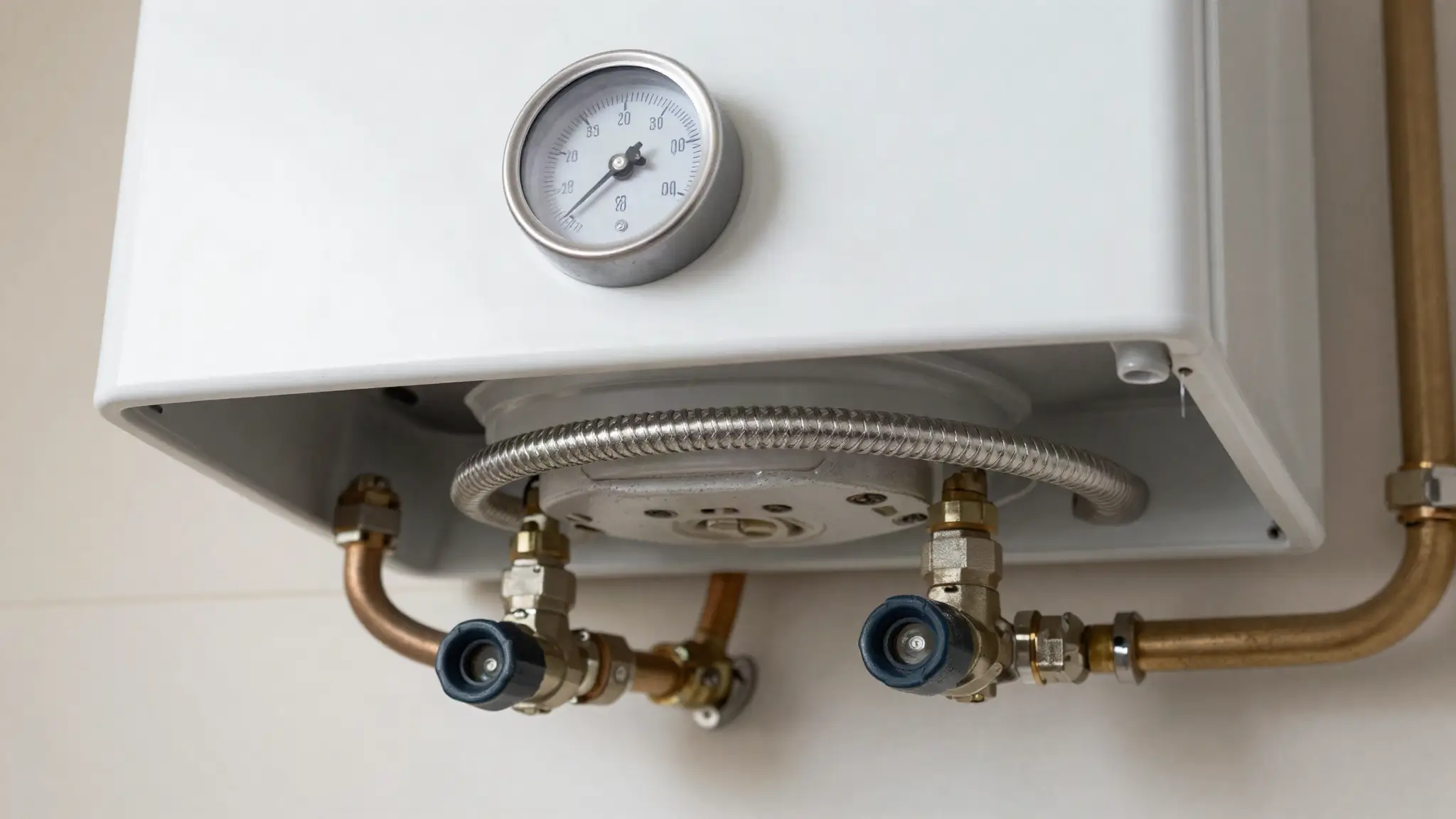
Most boilers have a round dial on the front or underneath, usually with a green band for the safe range and red at either end. Newer models show the pressure on the digital display instead, sometimes only after you press a button.
Take your reading first thing in the morning, before the heating comes on. A reading taken while the boiler is hot will look higher than the true resting pressure, and if you top up a hot system you can overshoot.
Why does my boiler keep losing pressure?
A sealed heating system is a closed loop, so if the pressure falls, water is getting out somewhere. The usual culprits are:
- Bleeding radiators. Letting air out also lets out a little pressure, so a top-up afterwards is expected.
- A small leak. Look for damp patches, rust marks or drips around radiator valves, towel rails and visible pipe joints. Vaillant says this is the most common cause.
- A leaking filling loop. If the loop is not attached firmly at both ends, it can drip.
- A fault inside the boiler, such as a worn pressure relief valve or a flat expansion vessel. These need an engineer.
Worcester Bosch says most systems need topping up once or twice a year. If you are reaching for the filling loop every few weeks, something needs fixing.
How to top up your boiler pressure
Every boiler is slightly different, so check your manual first. The steps below cover most combi and system boilers with a filling loop.
- Turn the boiler off and let it cool. You want an accurate reading, and you do not want to overshoot.
- Find the filling loop. On most boilers it is a braided silver hose with a small valve at each end, under the boiler. Some Worcester Bosch and Vaillant models have a built-in key or lever instead, which the manual will show you.
- Connect both ends if your loop is the removable kind, and make sure they are hand-tight.
- Open the valves slowly. You will hear water running. Watch the needle climb.
- Stop at 1 to 1.5 bar and close both valves fully.
- Remove the loop if it is detachable, keeping a towel underneath for the drips.
- Restart the boiler, reset it if it shows a fault, and check the gauge again later in the day.
If the needle carries on rising after you have closed the valves, one of them is not fully shut or is letting water past. Vaillant lists this as a common reason for pressure that creeps up on its own.
What if my boiler pressure is too high?
The most common reason is simply over-filling. Vaillant's advice: if the cold reading is under 2.5 bar, no action is needed. If it is over 2.5 bar, bring it down before running the boiler, by bleeding a radiator a little at a time until the needle drops back.
Do not try to release pressure through the safety valve yourself. That valve, often called the pressure relief valve, is there to discharge water through a pipe to the outside if the pressure reaches around 3 bar. If it keeps going off, or the pressure keeps rising after you have bled a radiator, book a Gas Safe registered engineer.
A worked example: after bleeding the radiators
It is the first cold week of November. You bleed three radiators upstairs that were cold at the top, and the hissing stops when water appears at each one.
- Before bleeding, the cool boiler read 1.3 bar.
- After bleeding, it reads 0.8 bar, below the 1 bar minimum.
- You top up through the filling loop to 1.3 bar and close both valves.
- With the heating on, the needle settles at 1.8 bar, inside the normal 1 to 2 bar range.
- Two weeks later it still reads 1.3 bar cold, so there is no leak to worry about.
If instead it had dropped to 0.8 bar again within days, that would be the cue to look for a leak and, if you cannot find one, to call an engineer.
When should I call an engineer?
- You need to top up more than a couple of times a year.
- The pressure rises by more than 1 bar as the boiler heats up. Worcester Bosch says the expansion vessel may need recharging, which is an engineer's job.
- Water is dripping from a pipe outside, or the pressure relief valve keeps discharging.
- The pressure stays high after you have bled a radiator.
- You can smell gas. Leave the property and call the National Gas Emergency number on 0800 111 999.
Anything inside the boiler casing is gas work, and by law it must be done by a Gas Safe registered engineer. You can check an engineer on the Gas Safe Register website.
Is it time for a new boiler?
A boiler that loses pressure now and again is normal. One that needs constant attention, alongside other faults, may be nearing the end of its life. Our guide on when to replace your boiler covers the signs, and boiler costs shows what a replacement typically involves.
Where to go next
- Weigh up your options in the boiler buying guide.
- Plan a replacement with the new boiler checklist.
- Considering a change of system? Read heat pump or gas boiler.
- Check help with costs on boiler and heating grants.
Common questions
Is it dangerous if my boiler pressure is low?
Not dangerous, but the boiler will usually stop working to protect itself. Topping it up normally gets it going again.
Should boiler pressure go up when the heating is on?
Yes, a little. Water expands as it heats, so a rise from about 1.2 to 1.8 bar is normal. A rise of more than 1 bar suggests the expansion vessel needs attention.
How often should I check my boiler pressure?
Glance at it once a month during the heating season, and always after bleeding radiators or if the heating stops.
Can I top up the pressure on a hot boiler?
It is better to wait until it has cooled. A hot system reads high, so you may overfill it.
Why is my boiler pressure at zero?
Either a lot of water has escaped, or the gauge itself has failed. Top up and watch it; if it will not hold, or the needle does not move, call an engineer.
Sources
- Vaillant, What pressure should my boiler be? Checked 5 November 2026.
- Worcester Bosch, How often should I need to top up the pressure in the heating system? Checked 5 November 2026.
- Baxi, What should my boiler pressure be set at? Checked 5 November 2026.
Boiler giving up on you?
If your boiler keeps losing pressure or breaking down, get a free, no-obligation replacement quote from a Gas Safe registered engineer.
Free and no obligation. We only share your details with the installers we match you with.
Keep reading
Unvented cylinder: how it works, costs and who can fit one
Are heat pumps worth it? Costs, savings and who they suit in 2026
What your boiler pressure gauge is telling you
Read the gauge with the heating off and the boiler cool, then find your reading in the left-hand column.